Hardwood Floor Refinishing Cost in Naperville (2026)
What refinishing actually costs across Naperville, DuPage, Will and Kane County — per square foot, by project size, and what makes one quote different from another.
Updated August 3, 2026·12 min read·By Angel Hardwood Floor Corp
The short answer
Most Naperville-area homeowners pay $3–$8 per square foot to have hardwood floors professionally sanded and refinished. A typical 500–1,000 sq ft project lands somewhere around $2,000–$6,500.
Where you fall in that range comes down to one thing more than any other: how much sanding your floors actually need. The rest of this guide walks through what moves the number up and down, so you can read a quote and know whether it makes sense.
Refinishing is the single highest-return thing you can do to a tired hardwood floor. You keep the wood you already own, you skip demolition and disposal entirely, and you end up with a floor that genuinely looks new — usually for somewhere between a quarter and a half of what replacement would run.
But “how much does it cost?” is a frustrating question to research, because most of what you find online is national-average data that ignores what your floors are actually like. A 1970s red oak floor in a Naperville split-level with two pets and thirty years of finish on it is not the same job as a five-year-old floor in a Plainfield subdivision that just needs freshening up — and they shouldn't cost the same.
This guide breaks down real pricing for the western suburbs, what drives it, and how to tell a fair quote from a bad one.
Refinishing is priced per square foot, and the number is driven by how many sanding passes your floors need and how much hand work is involved around the edges, corners, and closets. Here's how the tiers typically break down in the Naperville area:
Floor condition
Typical cost / sq ft
What this looks like
Light wear
$4.00–$4.75
Finish is dull or lightly scuffed. Wood underneath is sound and evenly colored. One or two passes and it's done.
Standard refinish
$4.75–$6.00
Visible traffic lanes, scratches through the finish, some discoloration. The most common job by a wide margin.
Heavy sanding & repairs
$6.00–$8.50+
Deep gouges, pet stains, water damage, boards to replace, or old adhesive to cut through. Multiple passes plus board work.
Buff & recoatno sanding
$1.00–$2.50
Not a true refinish. Screens the existing finish and adds a fresh coat. Only works if the wood itself is untouched.
These are market ranges for DuPage, Will, and Kane County — not a quote. Every floor is different, which is why we look at yours in person before putting a number on it.
What that means for your house
Square footage is the other half of the equation. Most homeowners underestimate it, because you're paying for finished floor area, not the room's footprint — closets count, and so does the space under furniture you plan to put back.
Using the standard refinish tier ($4.75–$6.00/sq ft), here's roughly where common projects land:
Project
Approx. area
Estimated total
Single bedroom
120–150 sq ft
$570–$900
Living room
300 sq ft
$1,425–$1,800
Living + dining
500 sq ft
$2,375–$3,000
Main floor of a typical suburban home
800–900 sq ft
$3,800–$5,400
Whole house, both levels
1,500–1,800 sq ft
$7,125–$10,800
Two things worth knowing about how size affects price. First, bigger jobs usually cost less per square foot — the setup, equipment haul, and dust containment are close to fixed costs, so spreading them over 1,200 sq ft is cheaper per foot than over 200. Second, lots of small rooms cost more than one big one of the same total area, because every doorway, closet, and corner is hand work that the big drum sander can't reach.
The 8 things that actually move the price
1. How many sanding passes the floor needs
This is the biggest single factor. A floor that needs one pass with fine grit costs dramatically less than one that needs to start at coarse grit and work up through three or four passes to level out gouges and remove old finish. When you get quotes that differ wildly, this is usually why — and it's the first thing to ask about.
2. Wood species
Red oak, which is what most floors in the western suburbs are made of, is the easy case: it sands predictably and takes stain evenly, typically $3–$5 per square foot in materials and labor terms. Softer woods like pine run higher ($4–$7) because they gouge easily and need a gentler, slower approach. Maple is dense and notorious for blotching when stained, so it often needs extra prep. Older Naperville homes near downtown are more likely to have pine or old-growth oak; newer subdivisions in Plainfield, Oswego, and Bolingbrook are almost always red oak.
3. Changing the stain color
Refinishing back to a natural or matching color is the baseline. Changing the color adds roughly $1–$3 per square foot, and it's real work, not a markup — the floor has to be sanded further to bare wood so no old color ghosts through, stain samples get tested on your actual boards in your actual light, and the stain needs additional dry time before finish coats go on.
If you're going from 1990s honey oak to something modern and darker, budget for this. It's the most common upgrade we're asked about and it's what transforms a room the most.
4. Finish type
Oil-based polyurethane is the traditional choice: durable, amber-toned, cheapest, and it smells strongly for several days. Water-based finishes cost more per gallon but cure faster, stay clear instead of yellowing, and have far less odor — which matters a lot if you have kids or pets and can't leave the house for a week. Hardwax oils and commercial-grade finishes sit at the top end. This choice can swing the total by 10–20%.
5. Stairs
Stairs are priced per tread, not per square foot, because they're almost entirely hand work — every tread, riser, nosing, and the spindles around them get sanded and finished individually.
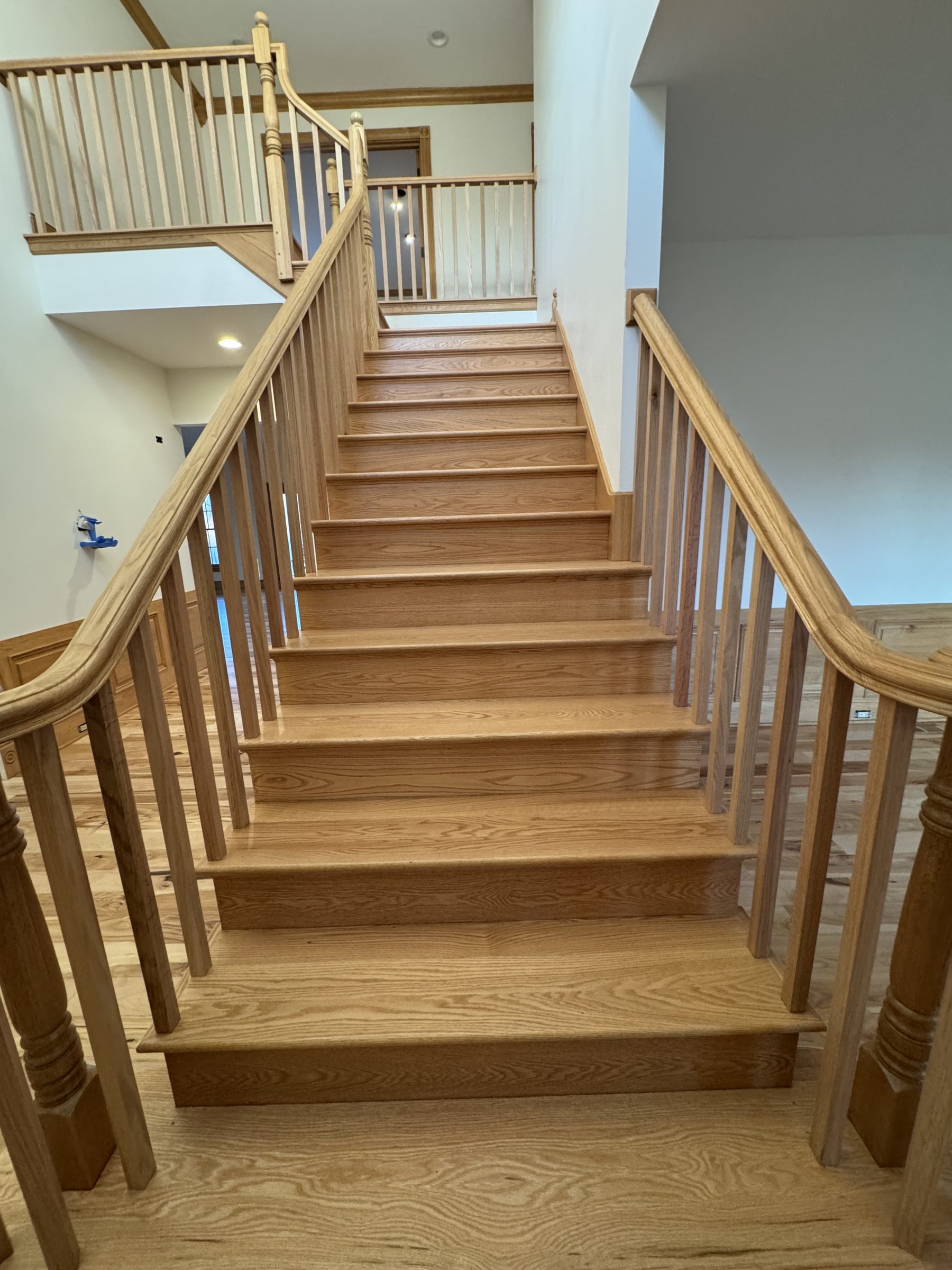
A full staircase — treads, risers, railing, and every baluster — is hand-sanded and finished. This is why stairs are quoted separately from floor area.
Expect $50–$150 per tread depending on scope, which puts a typical staircase somewhere around $700–$3,000. A straight 13-step run with simple square balusters is at the low end; a curved staircase with turned spindles and a landing is at the high end. If a quote for “the whole house” doesn't mention stairs, ask — that's a common place for a surprise line item to appear later.
6. Repairs and board replacement
Boards that are cupped from water damage, split, or stained all the way through can't be sanded out — they have to be cut out and replaced, then blended into the surrounding floor. Sourcing matching board for an older floor takes time, and the blend is skilled work. This is the line item most likely to be discovered mid-project rather than during the estimate, which is why a good contractor lifts a vent or checks a closet corner before quoting.
7. Dust containment
Traditional sanding with a bag makes a lot of fine dust that settles everywhere for weeks. Dust-containment systems that vacuum at the sanding head run $5–$8 per square foot all-in but keep the house dramatically cleaner. For an occupied home — especially one with anyone who has asthma or allergies — it's usually worth the difference.
8. Everything around the floor
Furniture moving, carpet and tack strip removal, staple and adhesive cleanup, shoe molding removal and reinstallation, and appliance disconnects are all real labor. Some contractors include them, some don't, and that alone can make two quotes look thousands of dollars apart when they're actually describing the same work.
What different damage levels actually look like
Pricing tiers are abstract until you see them. Here are two real jobs from around the western suburbs.
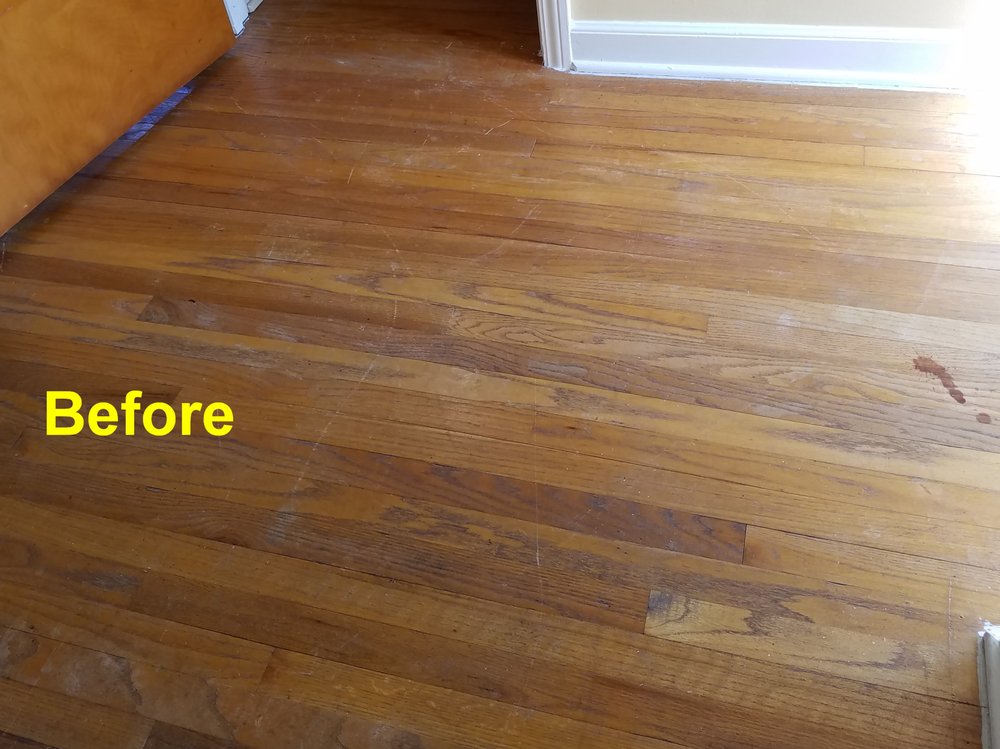
Surface wear and scratching — standard refinish
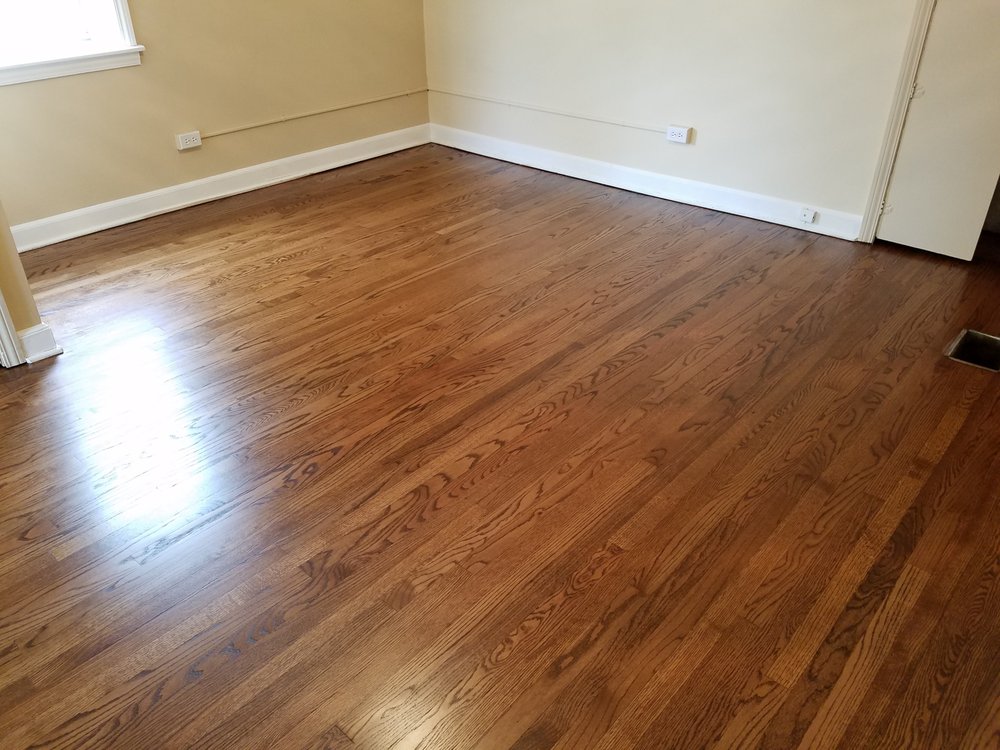
Before — scratched, dulled, and yellowed with a worn traffic path.After — sanded to bare wood, restained warmer and deeper, and sealed.
The wood here was completely sound. All the damage lived in the finish and the top fraction of an inch of wood, which is exactly what sanding removes. This is the standard tier — and note the color change, which is what makes the difference this dramatic.
Deep staining — heavy tier
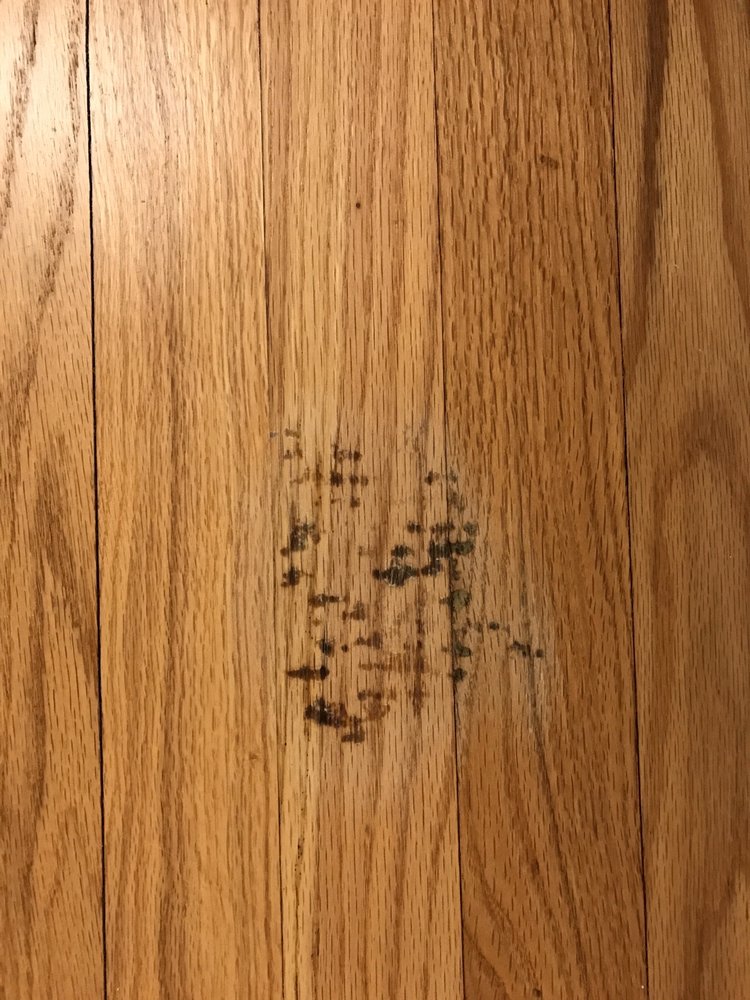
Before — dark staining that has penetrated well past the finish into the wood.After — sanded out and blended so the repair is invisible.
Black spotting like this is usually a pet accident or a long-term water leak reacting with tannins in the oak. It goes deeper than normal wear, so it needs aggressive sanding and sometimes board replacement — the heavy tier. The honest caveat: staining that has soaked through the full board thickness or reached the subfloor cannot be sanded away, and anyone who promises otherwise before looking at it is guessing.
The cheaper option most people don't ask about
If your floor's finish is worn but the wood underneath has never been scratched through, you may not need a full refinish at all. A buff and recoat (also called a screen-and-recoat) abrades the existing finish just enough for a new coat to bond, then applies fresh polyurethane over it.
At $1.00–$2.50 per square foot, it's a fraction of full refinishing, and it's done in a day instead of a week.
The test: put a drop of water on a worn area. If it beads up, the finish is still intact and a recoat will probably work. If it soaks in and darkens the wood, the finish is already breached and you need a full sanding.
A recoat won't fix scratches that reach the wood, won't change the color, and won't do anything about staining. But if you're just trying to restore sheen and buy another five to seven years before a real refinish, it's the best value in flooring — and a contractor who tells you that instead of selling you a full sand is one worth keeping.
Refinishing vs. replacing: the real comparison
The instinct when floors look bad is to price replacement. Usually that's the wrong instinct.
Refinishing
Replacing
Cost per sq ft
$3–$8
$6–$25 installed
800 sq ft main floor
$2,400–$6,400
$4,800–$20,000
Timeline
3–5 days plus cure
1–3 weeks incl. demolition
Demolition & disposal
None
Required, often a separate cost
Keeps original wood
Yes
No
Can change color
Yes
Yes
Can change species or plank width
No
Yes
Refinish when the wood is structurally sound and the problem is surface-level — wear, scratches, dull or dated finish, color you've stopped liking. That covers the large majority of floors we look at.
Replace when there's widespread moisture damage or cupping, structural movement in the subfloor, delamination, or the boards have simply been sanded too many times to have any wear layer left. Also replace if you want something the existing floor can't become — a different species, a wider plank, a herringbone pattern.
Some things refinishing can't do. A pattern change like herringbone means a new floor installation, not a refinish.
One more consideration that gets overlooked: solid hardwood can be sanded roughly 5–8 times over its lifetime. Every refinish you choose over a replacement is preserving an asset that would cost far more to reproduce today than it did to install.
Can your floor even be refinished?
Before pricing anything, it's worth confirming refinishing is on the table at all.
Solid hardwood is almost always a yes. Standard ¾" solid boards have plenty of wood above the tongue, and unless the floor has already been sanded several times you have room to work.
Engineered hardwood depends entirely on the wear layer — the real wood veneer over the plywood core. A 4–6mm wear layer can usually take one or two careful sandings. A 2mm wear layer can take a light screen-and-recoat at best; sanding it will go straight through into the plywood and ruin the floor permanently. This is not a judgment call to make from a photo.
Laminate and luxury vinyl cannot be refinished at all. The wood look is a printed layer. If yours is worn out, the only option is replacement.
How to check your wear layer: pull a floor vent and look at the cut edge of a board, or open a closet and check where the floor meets a threshold. You'll see either solid wood all the way down or a thin veneer over a layered core. Send us a photo of that edge and we can usually tell you straight away.
Timeline: what the week actually looks like
A typical whole-floor refinish runs 3–5 working days, plus cure time afterward. Roughly:
Day 1 — Prep and coarse sanding. Furniture out, shoe molding off, vents covered, containment set up. The first sanding pass removes old finish and levels the surface.
Day 2 — Fine sanding and edging. Progressively finer grits, then hand work along walls, in corners, and around closets. Gaps and nail holes get filled.
Day 3 — Stain. If you're changing color, stain goes on and needs to dry fully before anything else happens. Skipped on natural refinishes.
Days 4–5 — Finish coats. Two or three coats with buffing between them.
Mid-project: sanded to bare wood, baseboards pulled, first coat going down. Nothing goes back in the room until the finish has set.
Then the part people underestimate — curing. You can usually walk on it in socks after 24 hours. Furniture goes back after about 72 hours. Area rugs need to wait roughly two weeks, because finish continues off-gassing and a rug laid too early will trap solvent and leave a permanent outline. Water-based finishes cure faster than oil-based; your contractor should give you specific numbers for the product they're using.
Most families stay in the house for a natural refinish and leave for a day or two during staining if they're sensitive to odor. Whole-house jobs are harder to live through than single rooms, for the obvious reason that you can't get from one side to the other.
How to compare quotes without getting burned
Refinishing quotes are unusually hard to compare because contractors describe the same work differently. A few things to insist on:
Get the square footage in writing. If two quotes assume different areas, you're not comparing anything. Ask what number they measured.
Ask how many sanding passes are included and what happens if the floor needs more once the old finish is off.
Confirm what's included: furniture moving, shoe molding, carpet or staple removal, and cleanup. These are the usual gaps.
Get stairs quoted separately and explicitly, per tread.
Ask what finish product, how many coats, and what the cure schedule is.
Verify licensing and insurance in Illinois. Sanding equipment and solvent-based finishes in an occupied home are not something to take on faith.
The quote that's dramatically lower than the others is usually lower for a reason — fewer passes, thinner coats, no containment, or work that gets re-priced once the crew is already in your house. A refinish done badly is expensive to fix, because the only remedy is sanding the floor again and spending more of a wear layer you can't get back.
Why western-suburb pricing looks the way it does
Naperville, Wheaton, Downers Grove, and the surrounding towns have an unusually wide range of housing stock, and it shows up directly in refinishing quotes.
Homes near downtown Naperville and in the older parts of Wheaton and Geneva often have narrow-strip oak or pine from the 1920s–50s — beautiful wood, but frequently on its third or fourth refinish, sometimes with layers of old shellac or adhesive from carpet that was glued down in the 1970s. Those jobs skew toward the heavy tier.
The subdivisions built through the 1990s and 2000s in Plainfield, Oswego, Bolingbrook, and Romeoville are almost uniformly ¾" red oak with factory or site-applied polyurethane. They're straightforward, they've usually never been sanded, and they land in the light-to-standard range. The most common request there isn't damage repair at all — it's getting rid of the orange-toned honey oak finish that dates the whole house.
We work across all of these markets, and the estimate is free precisely because the only honest way to price a floor is to look at it.
Want a real number for your floors?
We'll come to your home anywhere in DuPage, Will, or Kane County, look at the wood, and give you a straight quote — no obligation and no pressure.
For a standard refinish at $4.75–$6.00 per square foot, 1,000 sq ft works out to roughly $4,750–$6,000. Floors in good shape needing only a light sanding can come in nearer $4,000, while heavy damage, board replacement, or a stain color change can push a 1,000 sq ft job past $8,000. Stairs are quoted separately, per tread.
Almost always, and usually by a wide margin. Refinishing runs $3–$8 per square foot, while new hardwood installed runs $6–$25 per square foot before demolition and disposal of the old floor. On an 800 sq ft main floor that is often the difference between roughly $2,400–$6,400 and $4,800–$20,000. Replacement only makes sense when the wood is structurally compromised or you want a different species, plank width, or pattern.
Solid ¾" hardwood can typically be sanded and refinished 5–8 times over its lifetime, depending on how aggressively each sanding was done. Engineered hardwood depends entirely on its wear layer: a 4–6mm veneer can usually take one or two sandings, while a 2mm veneer can take a light screen-and-recoat at best. We check board thickness during the estimate before recommending anything.
Most projects take 3–5 working days: coarse sanding on day one, fine sanding and edge work on day two, stain on day three if you are changing color, and finish coats over the last day or two. After that comes curing — light foot traffic after about 24 hours, furniture back after about 72 hours, and area rugs after roughly two weeks so the finish can fully off-gas.
Often, but not always. Dark spotting from pet accidents or leaks happens when moisture reacts with tannins in the wood. If it has only penetrated the upper portion of the board, aggressive sanding removes it completely. If it has soaked through the full thickness of the board or reached the subfloor, sanding will not reach it and those boards need to be cut out and replaced. Nobody can tell you which it is from a photo alone — it needs to be seen in person.
A buff and recoat abrades the existing finish and applies a fresh coat over it, without sanding down to bare wood. At $1.00–$2.50 per square foot and one day of work, it is a fraction of a full refinish. It only works if the finish is worn but not breached — a quick test is to drop water on a worn area: if it beads, a recoat will likely work; if it soaks in and darkens the wood, you need a full sanding. A recoat cannot fix scratches in the wood or change the color.
Yes, typically $1–$3 per square foot more. The floor has to be sanded further down to bare wood so no previous color shows through, stain samples are tested on your actual boards, and the stain needs additional drying time before finish coats go on. Going from dated honey oak to a modern medium or dark tone is the most common upgrade we are asked for, and it is what changes the look of a room the most.
Usually not. Most families stay in the house for a natural refinish, and many leave for a day or two during staining and the first finish coats if they are sensitive to odor. Water-based finishes have much less smell and cure faster than oil-based, which matters if you have small children or pets. Whole-house projects are harder to live through simply because you cannot cross the wet floor, so those are often done in two phases.