Hardwood Floor Repair
in Naperville, IL
Scratches, stains, water damage, gaps, squeaks — we diagnose and fix the actual problem. Most damaged floors can be repaired without full replacement, and we'll tell you honestly which yours needs.
Get a Free EstimateHardwood Floor Repair — Naperville & Western Suburbs
One of the most common calls we get from Naperville homeowners goes something like this: "We have damage on our hardwood and another company told us we need to replace the whole floor." In the vast majority of cases, that's not true — and it's expensive, unnecessary advice.
At Angel Hardwood Floor Corp, our default approach is to repair. We repair hardwood floors across DuPage and Will County, and we know exactly what can be saved and what genuinely needs replacement. We'll give you an honest assessment — and if repair is the right call, we'll do the repair at a fraction of what full replacement would cost.
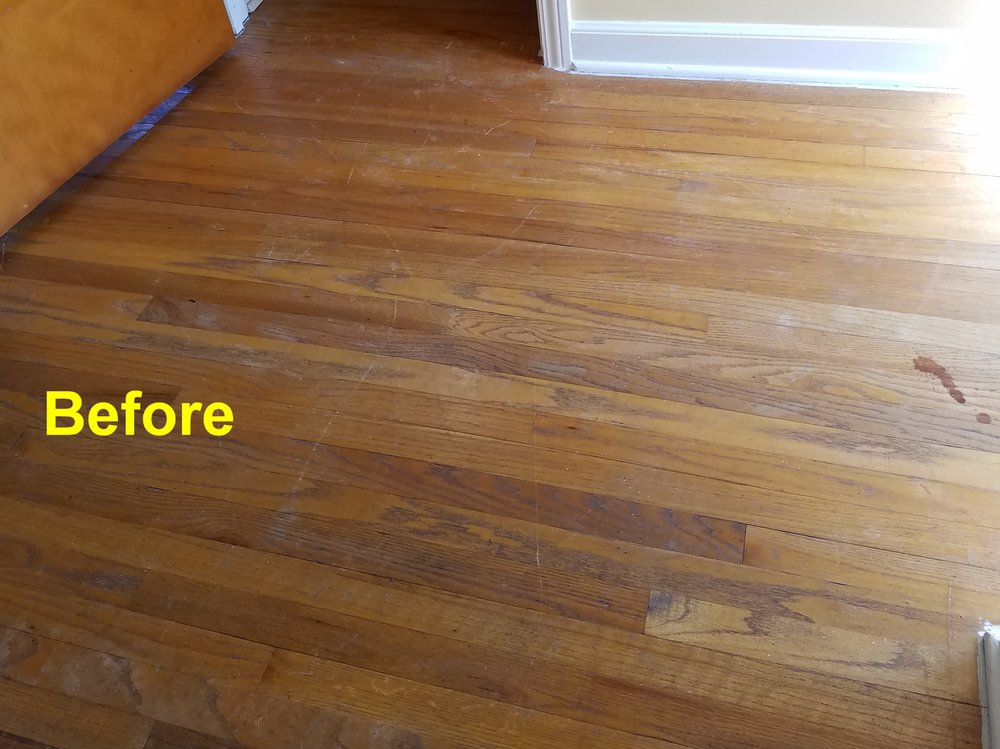
We handle everything from surface scratches and scuffs to deep water damage requiring board replacement. In most cases we can match the existing stain and finish well enough that the repair is invisible, or very close to it.
When the wear is spread across a whole room rather than a few boards, such as gray traffic lanes, dull finish throughout or a stain color you want to change, a full sand and fresh finish usually makes more sense than spot repairs. See our approach to floor restoration in Naperville, IL.
Types of Floor Damage We Repair
- Surface scratches and scuffs — often addressed with spot sanding and touch-up finish
- Deep gouges and dents — filled, sanded, and refinished to blend with surrounding boards
- Pet stains and urine damage — one of the most common repair requests; stains can often be sanded out or concealed with a darker stain color
- Water stains and discoloration — cup staining, black water rings, and surface discoloration
- Water damage and cupping — boards that have cupped or warped due to moisture infiltration
- Squeaky floors — located and silenced from above or below depending on access
- Gapping between boards — seasonal gaps vs. permanent gaps diagnosed and addressed appropriately
- Cracked, split, or splintering boards — individual boards replaced and matched
- Old patch jobs — previous repairs that didn't blend well, re-done properly
- Finish wear and dullness — spot refinishing or full-floor screen-and-recoat
Our Repair Process
Free In-Home Assessment
We come out, look at the damage, and give you an honest read on what's going on. We'll tell you exactly what the repair entails and what it will cost — before any commitment.
Damage Diagnosis
We identify the source and extent of the damage. Water damage, for example, needs to have the moisture source resolved before any floor repair — otherwise the damage comes back.
Targeted Repair
We repair only what needs to be repaired. Individual boards are replaced if needed; surrounding boards are sanded and blended. We don't pull up good flooring to charge more.
Stain & Finish Matching
Matching an existing stain and finish is a skill. We mix custom stain colors to match your existing floors as closely as possible, then apply finish coats that match the sheen level.
Final Inspection
We review the repair with you before we leave. If it doesn't look right, we address it. We don't consider a job done until the work meets our standard.
How Much Does Hardwood Floor Repair Cost in Naperville?
Repair costs vary considerably based on the type and extent of damage. Minor scratch touch-ups might cost $150–$300; replacing several water-damaged boards with stain matching might be $400–$800; more extensive damage involving multiple areas can run $800–$2,000+. In nearly every case, this is far less than full floor replacement which typically runs $8–$15+ per square foot installed.
The only way to give you an accurate number is to see the damage in person. Call us or request an estimate online and we'll come out at no charge.
You Might Also Need
Frequently Asked Questions
Often yes — it depends on how deep the staining has penetrated. Surface pet stains can usually be sanded out and re-stained. Deep, long-term pet staining that has penetrated into the wood may require board replacement. We'll assess the damage honestly and tell you what's possible before any work begins.
Yes — stain color matching is a core part of our repair work. We mix custom stain blends to match your existing floor as closely as possible. Perfect matching depends on the age of the finish, the wood species, and the stain type, but in most cases we can get very close.
If the damage is localized to specific boards or areas, repair is usually the right call. If the entire floor is dull, worn, or scratched throughout, a full sanding and refinishing may be more cost-effective. We'll look at both options and give you an honest recommendation during the free estimate.
Yes. We locate the source of the squeak and address it using the appropriate method — screwing through the subfloor, face-nailing boards, or injecting adhesive depending on the situation and accessibility. Most squeaks can be eliminated without major disruption to the floor surface.
First, address the source of the water. Repairing floors before the moisture issue is resolved will result in the damage returning. Once the moisture source is fixed and the area has dried fully, give us a call and we'll assess the extent of the damage and provide a repair quote.
We primarily specialize in hardwood floor repair and restoration. For vinyl and laminate, we can address damaged sections and transitions. If a section of LVP or laminate needs replacement, we'll let you know during the estimate.
Almost certainly not. Wood gives up moisture in a heated Illinois house and takes it back through a humid summer, so thin, even gaps that open in January and close again by July are the floor behaving normally rather than failing. Filling them in winter usually makes things worse, because the boards swell in summer against filler that cannot compress. The gaps worth repairing are the ones that stay open all year, the ones much wider in one part of a room than another, or gaps that come with boards moving underfoot. Our guide to why hardwood floors gap, cup and buckle in Illinois walks through how to tell the difference before you call anybody.
We would not, and you should be cautious with anyone who offers to. Cupping means the underside of the boards is wetter than the top, and sanding a floor flat while that moisture is still in it leaves the sanded edges sitting low once the wood finally dries — a crowned floor, which is a harder and sometimes unfixable problem. The right order is to find and stop the moisture, dry the floor, meter both the wood and the subfloor, and sand only once the readings are stable. That is exactly what we check on a cupping call, and we will tell you honestly if the answer is to wait a few weeks.
Usually, and the answer depends on what kind of floor it is. A site-finished floor is the easier case: the replacement boards only need to match in species, grade, width and thickness, because the stain and finish go on afterward and get blended into the room. Common strip oak in a standard width is still made and still easy to source, which covers most older floors out here. A discontinued prefinished product is harder, because the board arrives with its color, sheen and bevelled edges already on it and there is nothing to blend. When that happens, one good option is to take sound boards from a closet, a pantry or under an appliance to use in the visible room and put the new material where nobody looks. Our hardwood floor repair guide goes through the four things that have to line up for a match.
Usually not by the base policy, and this catches a lot of people with finished lower levels out here. The Illinois Department of Insurance describes Sewer Back-up and Sump Pump Overflow Coverage as coverage available for an additional premium that pays for damage to a finished basement caused by water backing up through a sewer, drain or overflow or discharged from a sump pump overflow, and it notes plainly that water seepage is not covered. Rising water is separate again, since standard home policies do not include flood coverage. We are flooring contractors rather than insurance advisors, so your agent is the right person to read your actual policy, but it is a much better question to ask before you need the answer than after. Our hardwood floor repair guide covers what to do in the first 48 hours of a water event.
We identify the species before ordering anything, because a board that looks close under an old finish can stand out once it is coated. Red and white oak are the usual candidates in Naperville houses, and they are easy to mix up until you look at a cut end: red oak's pores are open, white oak's are plugged. Maple and hickory turn up in newer kitchens and custom homes, and each takes stain very differently from oak, so a maple patch stained to match oak will never get there. Width and grade have to line up as well, and older houses sometimes have boards narrower than today's common strip, which means sourcing that size rather than ripping down a wider board by eye. Once species and size are right, the new pieces are woven in with staggered end joints and stained to blend.
Usually it is humidity coming up from below. Northern Illinois summers are humid, and a basement or crawlspace without a dehumidifier running lets moisture reach the underside of the subfloor and the boards above it, which swell on the bottom and curl up at the edges. The tell-tale pattern is cupping that appears in July or August, is worst over the basement or near the sump pit, and eases off by winter. On a call like this we meter the wood and subfloor, then ask about the dehumidifier, the sump, gutters and downspouts, and anything stored against the foundation walls. Often getting basement humidity under control lets the floor settle back over a season; any boards still cupped once the readings hold steady are sanded or replaced at that point, not before.
Fixing the obvious problems is usually worth doing; a full redo is rarely where we would start. Buyers and their inspectors notice pet stains, dark water marks near the sink or a door, soft or lifting boards and loud squeaks, and each of those invites questions or a request for a credit. Replacing the damaged boards and giving the main living areas a screen-and-recoat can make the floors photograph and show well without the downtime of a full sand. If the floor is worn through across whole rooms, a full refinish may be the better choice, and your listing agent can tell you how buyers in your part of Naperville are reacting. Book early, because repairs and finish need to be done and cured before the photographer arrives.
Only the ones that never touch the surface. A squeak caused by the subfloor pulling away from a joist can often be fixed from an unfinished basement, and that can happen before or after a refinish. Anything that changes the face of the floor should come first: replacing boards, fastening and filling from above, or filling gouges. Done before a full sand, the new wood and fills get sanded level and finished with the rest of the room. Done after, each one has to be stain-matched and spot-finished on a brand-new floor. Our guide to hardwood floor repair vs. refinishing walks through the order symptom by symptom.