Hardwood Floor Installation Cost in Naperville (2026)
What new hardwood actually costs across Naperville, DuPage, Will and Kane County — material versus labor, the prep nobody quotes up front, and how to read two very different bids for the same room.
Updated August 6, 2026·14 min read·By Angel Hardwood Floor Corp
The short answer
New hardwood in the Naperville area runs $7–$18 per square foot installed, material and labor together. Most western-suburb projects land between $10 and $14, which puts a typical 800 sq ft main floor somewhere around $8,000–$11,000.
That is a wide band, and the width is the point. Two houses on the same street can get quotes $6,000 apart for the same square footage, and almost all of the gap comes down to three decisions: what species you pick, whether the floor is finished in a factory or in your living room, and what has to happen to the subfloor before a single board goes down.
Hardwood is the one flooring material people rarely regret buying. It outlasts everything else in the house, it can be sanded and made new again decades later, and it is the only floor a buyer walks in and notices for the right reasons.
It is also the hardest flooring to price from a website. Search “hardwood floor installation cost” and you get a national average that folds a builder-grade engineered floor in a Texas subdivision into the same number as a site-finished white oak floor in a Wheaton Victorian. Those are not the same job and they should not share a price.
This guide breaks the number apart the way an estimator does — material, labor, prep, and the extras that show up late — using real ranges for DuPage, Will, and Kane County. If your floors are already wood and you are weighing whether to replace them at all, start with our refinishing cost guide instead; refinishing is usually the cheaper answer.
Installed cost is two numbers stacked on top of each other: the material you choose and the labor to put it down. Contractors quote them separately, together, or partly together, which is exactly why bids are so hard to line up side by side. Here is how the tiers break down in the western suburbs:
Floor type
Material / sq ft
Labor / sq ft
Typical all-in
Engineered hardwoodprefinished
$4.00–$9.00
$3.00–$6.00
$7–$15
Solid hardwoodprefinished
$4.00–$9.00
$4.00–$8.00
$8–$17
Solid hardwoodsite-finished
$3.00–$7.00
$6.00–$11.00
$9–$18
Luxury vinyl plank
$2.00–$6.00
$2.00–$5.00
$5–$11
Laminate
$1.50–$4.00
$2.00–$4.00
$4–$8
Market ranges for DuPage, Will, and Kane County — not a quote. Site-finished labor covers installation plus sanding and finishing in place. Old-floor removal and subfloor work are separate; both are covered further down.
A few things worth pulling out of that table. Site-finished solid wood is not more expensive because the wood costs more — unfinished boards are actually cheaper. It costs more because sanding and finishing your floor in your house is several extra days of skilled labor. And engineered hardwood is not the budget option people assume; a good engineered floor with a thick wear layer costs about what solid costs. The cheap engineered floors are cheap because the veneer on top is paper-thin, which is a decision with consequences we get into below.
If you are comparing hardwood against the alternatives, our luxury vinyl plank and laminate pages go deeper on where each one makes sense.
What that means for your house
Square footage is where most homeowners guess wrong, and always in the same direction — low. You are paying for finished floor area, which includes closets, the space under furniture, and the awkward strip behind a door that still has to be cut and fitted.
Using the middle of the range for prefinished solid hardwood ($10–$14 per square foot all-in), here is roughly where common projects land:
Project
Approx. area
Estimated total
Single bedroom
120–150 sq ft
$1,200–$2,100
Living room
300 sq ft
$3,000–$4,200
Living + dining
500 sq ft
$5,000–$7,000
Main floor of a typical suburban home
800–900 sq ft
$8,000–$12,600
Whole house, both levels
1,500–1,800 sq ft
$15,000–$25,200
Two patterns hold across almost every job. Bigger areas cost less per square foot, because delivery, setup, tool haul, and protection are close to fixed costs whether the room is 200 sq ft or 1,200. And a warren of small rooms costs more than one open space of the same total area, because every doorway, closet, corner, and transition is hand-cut work that eats time the open field does not.
There is a third pattern that only shows up on whole-house jobs: doing it all at once is cheaper per foot than doing it in phases, and it is the only way to guarantee the color matches. Wood from two different runs, ordered a year apart, will not be the same floor. If the budget only stretches to part of the house this year, plan the break at a doorway or a stair landing rather than in the middle of a sight line.
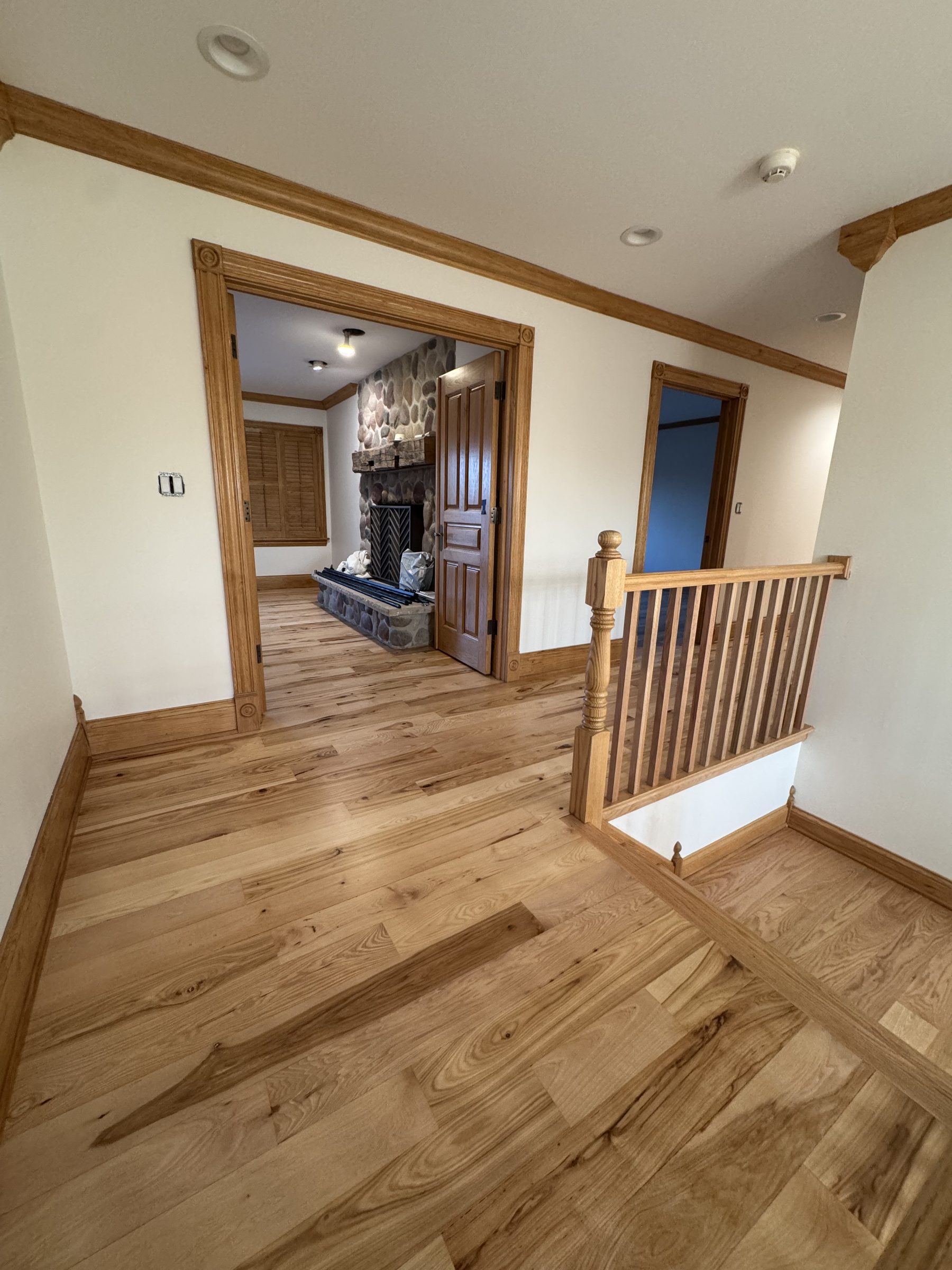
The same hickory floor carried through the upper hallway and landing, with the railing and trim finished to match. Running one floor continuously across a level is what makes a house read as finished — and it is easier to price and match when it is all one order.
Where the money actually goes
On a typical installed hardwood job, material accounts for something like 30–50% of the total and labor plus install-related work for the other 50–70%. That surprises people who assumed they were mostly buying wood.
It matters practically, for two reasons. First, upgrading your material is cheaper than it feels — moving from a $4 board to a $6 board on 800 sq ft adds about $1,600 to a job that is already five figures, and it is the part of the decision you look at every day for thirty years. Second, and less comfortably, a bid that is dramatically lower than the others is almost never saving you money on wood. The wood costs what it costs. The savings are coming out of labor, which means fewer prep hours, faster layout, less careful racking, and cut corners you cannot see until the floor tells on itself a year later.
What each wood species costs
Species is the single biggest lever you control on the material side. Current material ranges:
Species
Material / sq ft
What you are buying
Red oak
$3.00–$6.00
The default in western-suburb homes for decades. Sands predictably, takes stain evenly, easy to source and easy to match later. Warm pink-orange undertone.
White oak
$5.00–$10.00
The most requested species right now. Tighter grain, cooler undertone, and the only oak that reliably takes today's lighter and greyer colors without going muddy.
Maple
$4.00–$8.00
Harder than oak with a clean, near-uniform grain. Excellent natural or clear-coated; notorious for blotching when stained dark, so it needs extra prep.
Hickory
$4.00–$9.00
The hardest of the four and the most dramatic — wild color variation board to board. People either love it immediately or not at all.
White oak has led buyer preference for several years running, and it is not a coincidence: the shift toward lighter, cooler, less orange floors is exactly the shift red oak fights. If you want a pale natural or a soft grey and you are shopping on price, understand that red oak will need more work to get there and may never quite arrive. That is the honest trade behind the $2–$4 per square foot gap.
Hickory is the outlier in the list because you do not choose it for performance, you choose it for the look. It is exceptionally hard, and no two boards are the same.
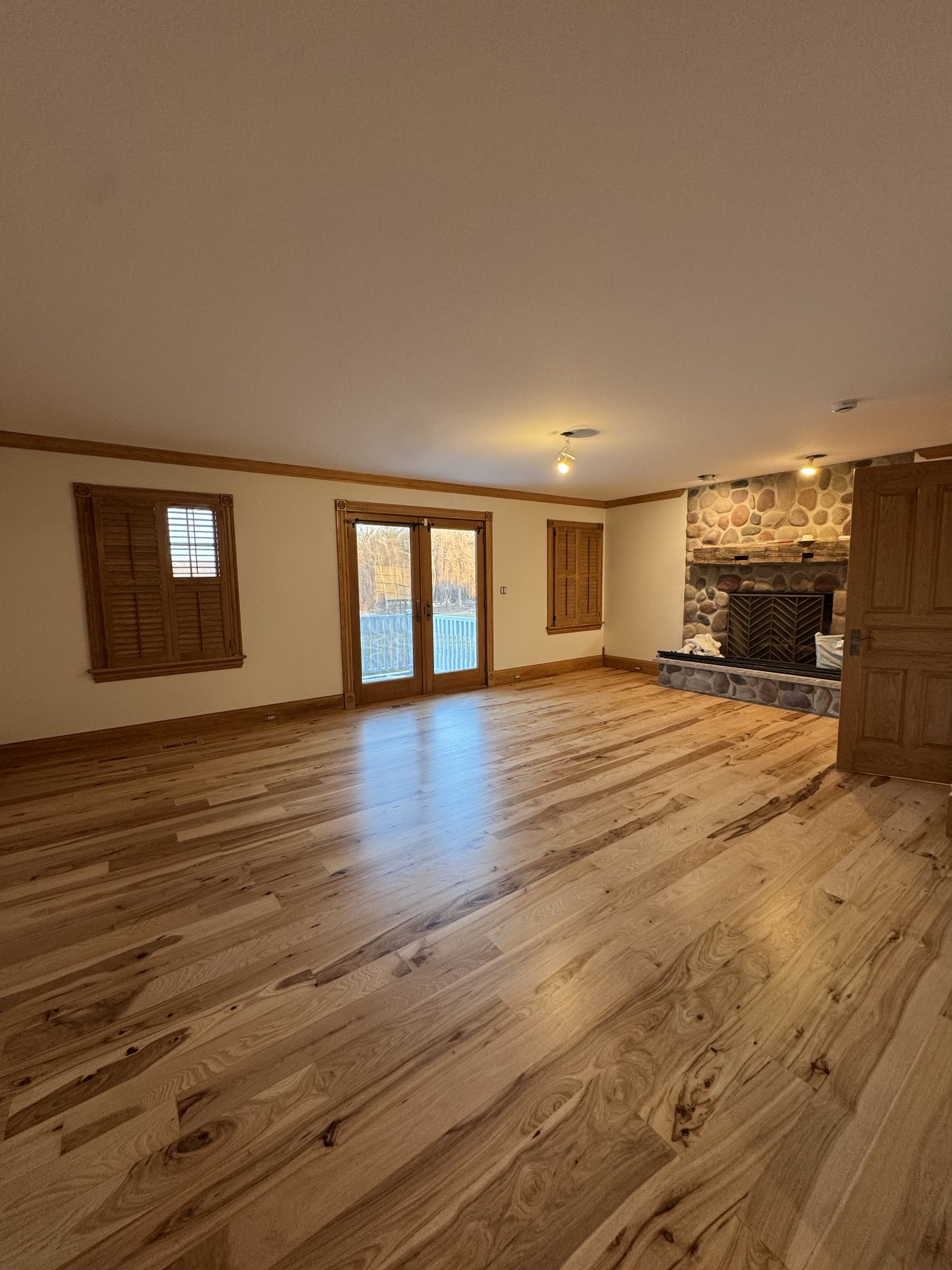
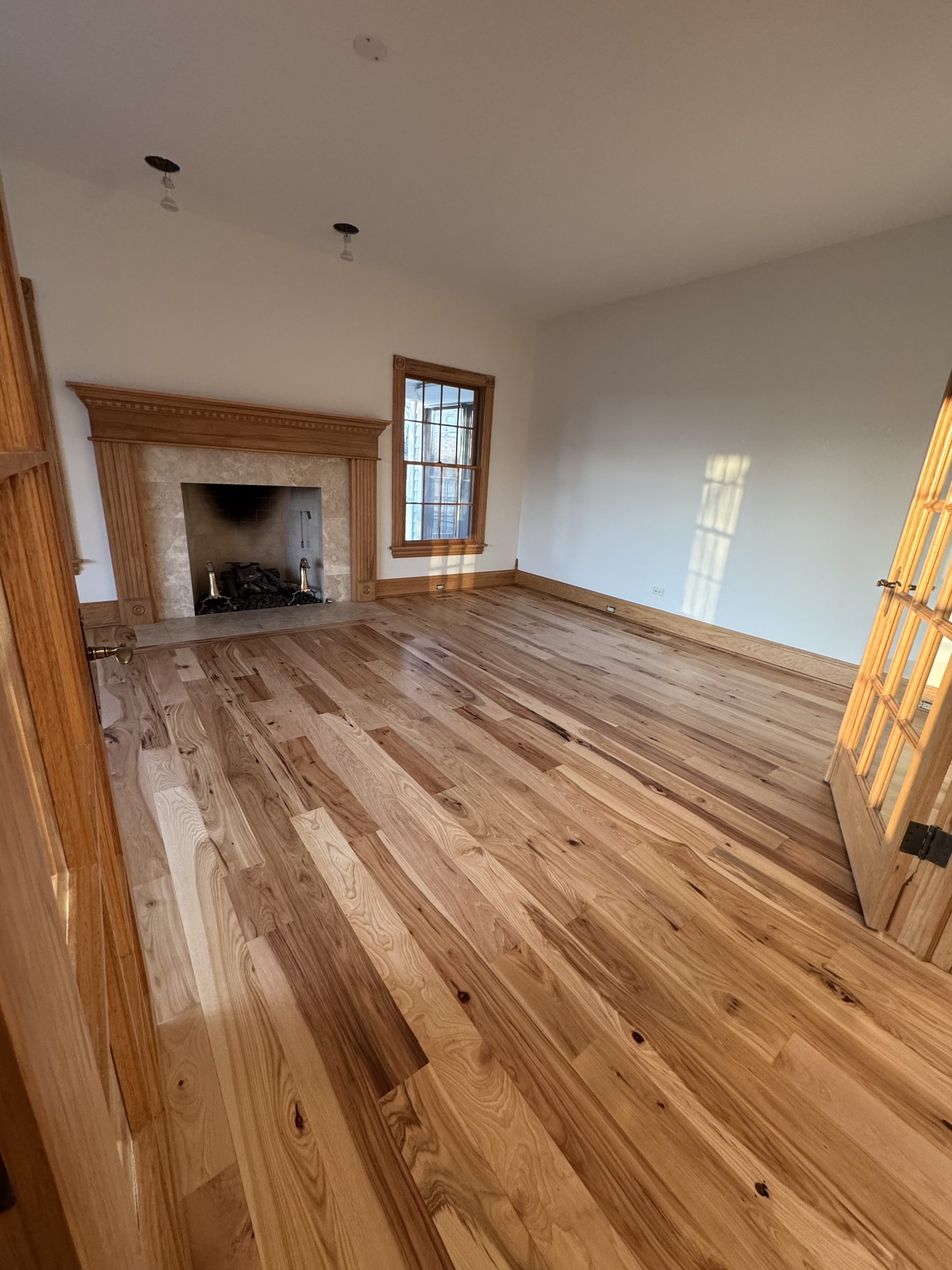
Wide-plank natural hickory in a formal room from a recent full-home installation — the color and grain variation is the wood itself, not a stain. More of this project is in the project gallery.
One more note on material budgeting that catches people out: order 5–10% more than your square footage. Every job produces waste at the cuts, some boards in every bundle are unusable, and you want a box left over in the garage for the day a dishwasher leaks. Ordering exactly to the measurement and needing three more boards from a different run six weeks later is a genuinely bad outcome.
Prefinished vs. site-finished: the fork in the road
This decision moves the price more than almost anything except species, and most homeowners have never heard it framed as a choice.
Prefinished boards arrive with the stain and multiple coats of finish already cured onto them in a factory. They are installed and the job is done that day. Site-finished (also called unfinished) boards arrive raw. They are installed, then sanded flat, then stained, then given two or three coats of finish, all inside your house.
Prefinished
Site-finished
Material
Higher — roughly $1–$2/sq ft more
Lower
Labor
Lower — install only
Higher — adds sanding and finishing
Typical installed
$6–$14
$8–$16
Days in your house
1–3 for most rooms
Add 3–5 days plus cure
Dust and odor
Minimal
Significant during sanding and finishing
Color options
What the manufacturer offers
Anything, tested on your actual boards
Surface
Micro-bevel between boards
Completely flat, seamless
Matching existing floors
Difficult
Straightforward
The added cost of finishing on site is roughly $2–$4 per square foot on top of standard installation labor, and it buys you two things that are genuinely hard to get any other way: any color you can imagine, and a dead-flat floor with no bevel line collecting grit between each board.
The rule of thumb: if you are flooring a whole level and want a specific color, or you are extending into a room next to existing hardwood you need to match, site-finished is usually worth it. If you are flooring one or two rooms, you like a color you have seen in a showroom, and you would rather not live through sanding, prefinished is the better buy — and it is genuinely more scratch-resistant out of the box, because factory finishes are cured under UV in ways nobody can replicate in a house.
Solid vs. engineered in a western-suburb home
Both are real wood. The difference is what is underneath the wood you walk on.
Solid hardwood is one piece of wood, typically ¾" thick, all the way through. It can be sanded and refinished many times over its life — realistically five to eight — which means a solid floor installed today can outlive the people who chose it. Its weakness is moisture: it expands and contracts across the grain with humidity, so it wants a stable indoor climate and a wood subfloor. It generally cannot go directly over concrete, and in most cases it should not go over radiant heat.
Engineered hardwood is a real wood veneer bonded to a plywood core. Because the core layers run in alternating directions, it moves far less than solid wood when humidity swings, which is why it handles concrete, radiant heat, below-grade rooms, and subfloor variation better. Its limit is the veneer: a 4–6mm wear layer can typically take one to three sandings over its life, and a 2mm wear layer can take a light screen-and-recoat at best.
For a western-suburb house, that usually resolves cleanly:
Main floor and upstairs, over a wood subfloor — either works. Solid is the better long-run value if you plan to stay, because of the refinishing headroom.
Basement or any below-grade room — engineered, or a waterproof product. Not solid.
Over a concrete slab or radiant heat — engineered.
A condo or high-rise with a concrete deck — engineered, and check the building's sound-transmission rules before ordering anything.
If you go engineered, ask for the wear-layer thickness in millimetres and get it in writing. It is the single number that determines whether the floor can be refinished in fifteen years or has to be thrown away. Two engineered floors at the same price per square foot can differ by a factor of three on this, and it is not printed on the showroom sample.
Our hardwood flooring page walks through the species and construction options in more detail, and we go through it in person on every estimate.
Plank width and pattern
Two aesthetic choices carry real cost, and both are worth knowing before you fall in love with a photo.
Wide plank
Standard strip flooring is 2¼" to 3¼" wide. Wide plank generally starts at 5" and runs to 7" or beyond. Wider boards cost more per square foot as material, because a wide board requires a bigger, cleaner log and yields less usable lumber. They also move more with humidity than narrow boards do, which makes acclimation and subfloor flatness more important, not less — a wide-plank floor installed carelessly will show gaps in February that a strip floor would have hidden.
Herringbone and chevron
Patterned installations are where labor climbs steeply. Every board is cut and fitted individually, the subfloor has to be genuinely flat rather than approximately flat, and the layout has to be squared off a centerline before anything is fastened — get that wrong and the error compounds visibly across the room. Expect a pattern to add meaningfully to installation labor over a straight lay of the same material, and expect the job to take longer.
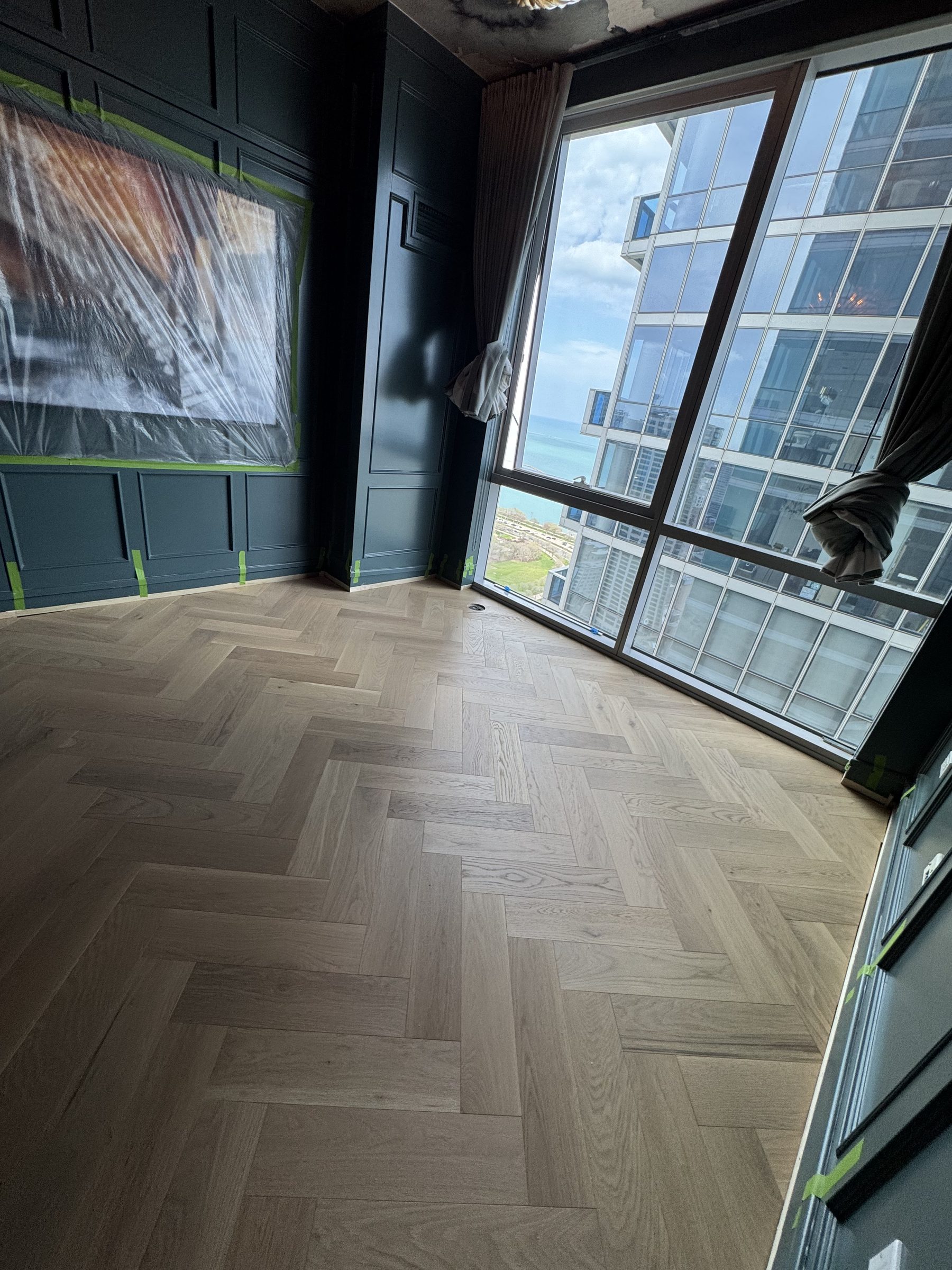
A herringbone installation in progress in a downtown Chicago high-rise — trim still taped, pattern squared off a centerline. We install herringbone and chevron in white oak, red oak, and engineered wood across the city and the western suburbs.
None of this is a reason to avoid a pattern. It is a reason to get it quoted as a pattern rather than assuming a per-square-foot number from a straight-lay job carries over.
The prep nobody quotes up front
This is where installation quotes diverge most, and where a “cheap” bid usually turns expensive. New flooring only goes down over a clean, flat, dry, structurally sound subfloor. Getting there is separate work.
Removing what is there now
Existing floor
Removal / sq ft
Why
Carpet and pad
$0.50–$1.00
Easiest by a distance. Cut, roll, haul — plus pulling hundreds of staples and the tack strip.
Laminate or vinyl plank
$0.50–$1.50
Floating floors lift quickly. Glue-down vinyl is slower because the adhesive has to come off the subfloor.
Old nail-down hardwood
$3.00–$6.00
Every board is fastened. Slow, loud, and it frequently damages the subfloor on the way out.
Ceramic or porcelain tile
$4.00–$8.00
The worst of the group. The mortar bed and often the backer board have to come up too.
Disposal is usually another $0.10–$0.40 per square foot, or a dumpster at roughly $300–$400 per week on a job big enough to need one. Some contractors fold removal and disposal into the installed price and some list them separately — neither is wrong, but you have to know which you are looking at before you compare two numbers.
Subfloor repair and leveling
Basic prep — screwing down squeaks, patching, a moisture barrier — runs from nothing to about $2 per square foot. Serious leveling with a self-levelling compound costs more, and a subfloor with rot, water damage, or structural movement is a repair job before it is a flooring job.
Hardwood is unforgiving about flatness in a way carpet never was. Carpet and pad hid every dip and hump in your subfloor for twenty years; a rigid wood floor will not. Laid over an uneven subfloor it will squeak, the joints will separate, and in a floating installation it will eventually crack at the locking edges. Any bid that does not mention checking the subfloor has not checked the subfloor. This is the single most common source of a mid-project change order, and the only defence is a contractor who lifts a vent, pulls back a corner of carpet, and puts a straightedge down before writing a number.
If your existing floor is wood and the damage is localized rather than universal, it is worth having someone look at whether targeted board repair would get you where you want to go for a fraction of a full replacement.
Stairs, trim, and transitions
Three line items live outside the per-square-foot number, and all three are common places for a surprise to appear after you have signed.
Stairs are quoted per tread, never per square foot, because they are almost entirely hand work — every tread, riser, nosing, and the balusters around them get handled individually. For reference, refinishing existing stairs runs $50–$150 per tread depending on scope; new treads and risers to match a new floor are quoted per project after we see the staircase, because the range depends heavily on what is there now. If a whole-house bid does not mention the stairs, ask before you sign — a staircase is a meaningful number and nobody enjoys discovering it in week two. Our stair and fixture refinishing page covers what that work involves.
Trim and shoe molding. New flooring needs an expansion gap at every wall, and something has to cover it. Reusing the existing shoe molding is possible if it comes off cleanly and the new floor sits at the same height; often it does not, and new quarter-round or base shoe gets added, then painted or stained to match.
Transitions and height changes. Where the new floor meets tile, carpet, or a room you are not doing, there is a threshold. Where the new floor is thicker or thinner than what came out, doors may need to be trimmed at the bottom and appliances may no longer slide under a counter the way they used to. None of these is expensive on its own. All of them are annoying to discover late.
Acclimation and Illinois humidity
This section has no dollar figure attached and it is still the most valuable part of this guide, because it is where installations go wrong in this specific climate.
Wood is hygroscopic — it takes on and gives up moisture from the air around it, expanding and contracting across the grain as it does. Northern Illinois puts a floor through a brutal annual cycle: humid, heavy summers and then months of forced-air heat that drops indoor humidity to desert levels. A floor installed without accounting for that will gap in January, and in a bad case will cup or buckle in July.
The National Wood Flooring Association's guidance is specific. Before installation, the house should be at 60–80°F and 30–50% relative humidity — meaning the HVAC is running, not switched on the morning the crew arrives. The wood's moisture content should be within 2–4% of the subfloor's, which in most of the country means flooring at roughly 6–9% and subfloor at 8–12%. Both get metered, not eyeballed.
What this means for scheduling: material typically sits in the house before installation so it can equalize with the room it will live in. Rushing that step is how you get a floor with visible winter gaps in its first year. If a contractor offers to deliver and install the same day on a solid wood floor, ask how they are handling acclimation — there are legitimate answers, and “we don't bother” is not one of them.
It also means the job does not end when the crew leaves. A wood floor in this climate wants that same 30–50% relative humidity year-round, which in practice means a humidifier through a northern Illinois winter. Some seasonal movement is normal and expected in every wood floor; the goal is keeping it small enough that you never notice it.
Timeline: what the job actually looks like
For a prefinished installation over a sound subfloor, most residential projects run 1–3 days, with whole-home jobs at 4–5. Roughly:
Before day 1 — acclimation. Material delivered, HVAC running, wood and subfloor metered.
Day 1 — Removal and prep. Old floor out, staples and tack strip pulled, subfloor cleaned, checked with a straightedge, patched and levelled as needed. Shoe molding off.
Days 1–3 — Layout and installation. Underlayment or moisture barrier, starting line squared off the room, then boards racked and fastened with the seams staggered so the pattern reads naturally rather than repeating.
Final day — Trim and transitions. Shoe molding on, thresholds fitted, doors trimmed if needed, cleanup.
Site-finished floors add three to five more days for sanding, staining, and finish coats, plus cure time afterward: socks after about 24 hours, furniture back after about 72, and area rugs held off for roughly two weeks so the finish can finish off-gassing. A rug laid down too early traps solvent and leaves a permanent outline.
Prefinished floors can generally be walked on and furnished right away, which is a real advantage in an occupied house with kids or pets. The full floor installation process is laid out step by step on our services page.
Should you install or refinish?
If there is already hardwood under your feet, this question comes before every number on this page.
Refinishing runs $3–$8 per square foot. New hardwood installed runs $7–$18. On an 800 sq ft main floor that is often the difference between roughly $2,400–$6,400 and $5,600–$14,400 — and the refinished floor is the same wood, sanded back to new, in whatever color you want.
Refinish when the wood is structurally sound and the problem is surface-level: wear, scratches, a dull or dated finish, or a color you have stopped liking. That describes the large majority of floors we are called out to look at. Our refinishing service page covers what that work involves, and the refinishing cost guide breaks the pricing down the same way this one does.
Install new when the boards are cupped from moisture, the subfloor has moved, an engineered floor has no wear layer left, the wood has been sanded as many times as it can take — or when you want something the existing floor simply cannot become. A different species, a wider plank, or a herringbone pattern is a new floor, not a refinish.
How to compare installation quotes
Installation bids are hard to compare because two contractors will describe the same job in completely different structures. Insist on these and the comparison becomes possible:
Material and labor broken out separately, with the exact product — manufacturer, collection, species, width, and for engineered, the wear-layer thickness in millimetres.
The square footage they measured, in writing. If two bids assume different areas you are not comparing anything.
Removal and disposal: included or extra, and at what rate.
Subfloor prep: what they found when they checked, what is included, and what happens — and at what price — if more is discovered once the old floor is up.
Stairs, trim, shoe molding, and transitions, each listed explicitly rather than assumed.
Acclimation and delivery timing, so you know the material is not going down the hour it comes off the truck.
Furniture and appliance handling, and who is responsible for what.
Licensing and insurance in Illinois, verified rather than assumed.
The warranty, separated into the manufacturer's warranty on the product and the contractor's warranty on the installation. They are different things, and installation problems are the ones that actually happen.
A bid dramatically below the others is worth understanding rather than celebrating. On a job where wood is half the cost and the wood costs what it costs, a big discount is coming from somewhere — thinner material, skipped acclimation, no subfloor prep, or a price that gets revised once the crew is already in your house and the old floor is in a dumpster.
Why western-suburb pricing looks the way it does
The housing stock out here is unusually varied, and it shows up directly in installation quotes.
Older homes near downtown Naperville and in the established parts of Wheaton, Geneva, and St. Charles often have plank subfloors rather than modern sheet goods, decades of settlement, and floors that are noticeably out of level. That is not a defect — it is a ninety-year-old house behaving like one — but it means real prep, and a bid on one of these homes that skips the subfloor conversation should be treated with suspicion.
The subdivisions built through the 1990s and 2000s across Plainfield, Oswego, Bolingbrook, and Romeoville are the opposite case: consistent construction, plywood or OSB subfloors in known condition, and predictable prep. Installations there are more straightforward and price accordingly. The most common project in those neighborhoods is not repairing damage at all — it is replacing builder-grade carpet on a main floor with real wood, or moving off an orange-toned honey oak that dates the whole house.
We install across all sixteen of these towns, and the estimate is free because the only honest way to price a floor is to stand on the subfloor and look at it.
Want a real number for your floors?
We'll come to your home anywhere in DuPage, Will, or Kane County, look at the subfloor, talk through species and finish, and give you a straight quote — no obligation and no pressure.
At $10–$14 per square foot all-in for prefinished solid hardwood, 1,000 sq ft lands around $10,000–$14,000 including material, labor, and normal prep. A budget-conscious engineered floor over a clean, level subfloor can come in nearer $7,000, while site-finished white oak, a wide plank, or a herringbone pattern can push the same room past $18,000. Removing an old floor and leveling the subfloor are separate line items on top of that.
Prefinished is usually cheaper overall. The boards themselves cost roughly $1–$2 per square foot more because the factory finish is already on them, but you skip the on-site sanding and finishing labor, which runs about $2–$4 per square foot. Prefinished typically lands around $6–$14 per square foot installed against $8–$16 for site-finished. Site-finished costs more but gives you any color you want and a completely flat surface with no micro-bevel between boards.
It depends entirely on what is coming out. Carpet and pad is the cheapest at roughly $0.50–$1.00 per square foot. Laminate or vinyl plank runs about $0.50–$1.50. Old nail-down hardwood is far more work at roughly $3–$6, and ceramic or porcelain tile is the worst of the group at roughly $4–$8 because the mortar bed has to come up too. Disposal is usually another $0.10–$0.40 per square foot, or a dumpster at $300–$400 a week on a large job.
Both work on a main floor over a wood subfloor. Solid hardwood is the better long-term choice there because it can be sanded and refinished many more times. Engineered is the better choice over concrete, over radiant heat, and in a basement or any below-grade space, because its plywood core moves far less when humidity swings. In a western-suburb home that usually means solid upstairs and on the main level, engineered below grade.
Yes. Red oak material typically runs about $3–$6 per square foot and white oak about $5–$10. White oak has been the more requested species for several years because its grain is tighter and its undertone is cooler, which suits current lighter and greyer stain colors. Red oak has a pink-orange undertone that fights those colors. Both are excellent floors, and red oak is the more economical of the two by a clear margin.
A prefinished installation over a sound subfloor usually takes 1–3 days for a normal room count, and 4–5 days for a whole home. Site-finished floors take longer because sanding, staining, and two or three coats of finish happen after the boards are down, which usually adds three to five days plus cure time. Old-floor removal, subfloor repair, and acclimation are scheduled before any of that starts.
Yes, and skipping it is one of the most common causes of gapping and cupping later. The National Wood Flooring Association calls for the house to be at 60–80°F and 30–50% relative humidity, with the wood's moisture content within 2–4% of the subfloor's before a single board goes down. In practice that means the heat or air conditioning is running, the material sits in the house first, and both the wood and the subfloor get metered rather than guessed at.
Almost always, and usually by a wide margin. Refinishing runs $3–$8 per square foot against $7–$18 for new hardwood installed. If the existing wood is structurally sound and the problem is wear, scratches, or a dated color, refinishing is the better value every time. New installation earns its price when the floor is beyond saving, when there is no wood there yet, or when you want something the existing floor cannot become — a different species, a wider plank, or a herringbone pattern.