Why Hardwood Floors Gap, Cup and Buckle in Illinois
Your floor is not defective — it is responding to a climate that swings from humid August afternoons to bone-dry January furnace air. Here is what is normal, what is not, and the one mistake that turns a fixable floor into an expensive one.
Updated August 13, 2026·13 min read·By Angel Hardwood Floor Corp
The short answer
Hardwood moves with the moisture in the air around it. In an Illinois house that means thin gaps that open between boards in winter and close again by midsummer are normal. Cupping, crowning, buckling, or gaps that never close are not — those are a moisture problem with a location, and they can be found.
The costly mistake is sanding too early. A cupped floor that gets sanded flat while it is still wet dries into a crowned floor, which is a harder and sometimes unfixable problem. Find the water, stop it, dry the wood, measure it — then decide what the floor needs.
Every August we get the same phone call. A homeowner walks across their living room barefoot, feels a ridge that was not there in April, looks down the length of the floor with the light raking across it, and sees every board edge standing slightly proud of its middle. The floor looks like a very shallow washboard.
And every January we get the other version of that call. The gaps. Thin dark lines opening up between boards that were tight all summer, wide enough to catch a fingernail, running the length of a room that looked perfect three months ago.
Both calls usually end the same way: nothing is wrong with your floor. But sometimes something genuinely is, and the difference between the two matters a great deal, because one of them costs nothing to fix and the other gets worse every week you leave it. This guide is how we tell them apart on an estimate, written out so you can do most of it yourself before you call anybody.
Wood is hygroscopic, which is a technical way of saying it is never finished trading moisture with the air. A board in your living room is constantly either absorbing water vapor from the room or releasing it, chasing a balance point that shifts every time the weather or your thermostat does. Take on moisture and the board swells. Give it up and the board shrinks.
Two details about that movement explain almost every floor problem in this article.
The first is that wood moves across its width, not along its length. A 2¼-inch red oak strip will grow and shrink measurably edge to edge across a season and effectively not at all end to end. That is why gaps show up as lines running with the boards and never as cracks across them, and it is why a wider plank shows more seasonal movement than a narrow one — the same percentage change applied to a 7-inch board is nearly three times the gap of a 2¼-inch board.
The second is that a board can be wetter on one face than the other, and when it is, it does not just swell — it curls. That asymmetry is the entire mechanism behind cupping and crowning. A floor that is uniformly wet or uniformly dry stays flat and simply changes size. A floor that is wet underneath and dry on top deforms.
None of this is a defect in the material, and none of it can be engineered away in a solid wood floor. It is the tradeoff you accept in exchange for a floor that can be sanded back to new several times across fifty years, which is a trade almost every homeowner would make again. What you can control is how far the swing goes.
The Illinois humidity swing
This is where the western suburbs earn their reputation with wood floors. Chicago-area outdoor relative humidity actually averages in the sixties and seventies most of the year, which sounds stable and is thoroughly misleading, because what a floor responds to is the air inside your house.
Cold air holds very little actual moisture. When your furnace pulls in 15°F air and heats it to 70°F, the relative humidity of that air collapses. A western-suburb house in a January cold snap, running forced air with no humidifier, can sit under 20% relative humidity for weeks — drier than a lot of deserts. Then July arrives, the same house sits in genuinely humid air, and if the air conditioning is off during a mild stretch the indoor number climbs into the sixties or higher.
The National Wood Flooring Association asks for 60–80°F and 30–50% relative humidity year-round. That is the band wood flooring is manufactured, acclimated and installed to live in. Here is roughly what a floor does on either side of it:
Indoor conditions
What the wood does
What you see
Below 25% RHdeep winter
Boards release moisture and shrink across their width
Thin, even gaps between boards; occasional face checking on older wood
30–50% RHtarget
Boards hold close to their installed moisture content
Tight seams, flat floor, minimal seasonal change
55–65% RHhumid summer
Boards absorb moisture and swell
Gaps close; mild cupping possible, especially over a damp crawl space or slab
Above 65% RH, or liquid waterproblem
Boards swell past the space available and press on each other
Pronounced cupping, crushed edges, and eventually buckling
General wood-behavior guidance for a Chicago-area heating and cooling season — not a diagnosis. Every house sits somewhere different depending on its HVAC, its basement, and how it is lived in.
The practical takeaway is that most floors out here do not have a problem. They have an amplitude — a distance between their January self and their July self. Narrowing that swing is most of the job.
Direct sun through south- and west-facing glass drives moisture out of the boards beneath it faster than the rest of the room. It is one reason gaps and color changes often appear in a band along a window wall first, while the middle of the room still looks fine.
Winter gaps: what is normal and what is not
Seasonal gaps are the most common wood-floor complaint we hear, and the great majority of them need no repair at all. The NWFA treats gaps that open and close with the seasons as normal behavior, not a defect.
What a normal winter gap looks like
Normal gaps are thin, fairly even, and spread across the whole room. They appear in the dry months and close again as humidity comes back. On a 2¼-inch strip floor they are usually hairline to about the thickness of a credit card. They show up everywhere the floor runs, not clustered in one corner. And critically: they are gone by August.
When a gap is telling you something
Start paying attention when any of these are true:
The gaps never close. A gap that is the same width in February and in August is not seasonal. It means the wood dried below where it should ever have been, or the boards were installed at a moisture content that did not match the house.
One area is dramatically worse. Gaps concentrated near a heat register, a fireplace, a sun-blasted patio door, or above a heated crawl space point at a localized drying problem, not a whole-house one.
One gap is enormous and the rest are tight. That is usually a fastening issue rather than a humidity one — the floor has moved as a block and opened in a single place.
Boards move or click underfoot at the gap. Loose boards need mechanical attention regardless of humidity.
The gap is wide enough to catch a dime and stays that way. At that point filling, lacing in boards, or refinishing becomes a real conversation.
One thing we would ask you not to do: do not fill seasonal gaps with wood filler in January. The boards will swell again in the summer and press against filler that will not compress, and you can end up with crushed board edges or filler squeezed up above the floor surface. Filling is for gaps that have proven they are permanent, and it is normally done as part of a sanding and refinishing job rather than on its own.
Summer cupping: edges up, middle low
Cupping is the one that alarms people, and it should get more attention than gaps do, because it always means the same thing: the underside of your floor is wetter than the top of it. The bottom of each board swells, the top does not, and the board curls upward at its edges.
That moisture differential has a source. Sometimes it is the whole house sitting at 65% humidity through a muggy week with the air conditioning off, in which case the floor is likely to relax on its own once the house dries out. But often it is water with an address — and mild cupping is frequently the earliest visible sign of a leak that has not shown up anywhere else yet.
Reading where the cupping is
Location is the best diagnostic you have. Cupping spread evenly across an entire level, appearing in August and easing in October, reads as seasonal. Cupping that is worst in a defined patch tells a more specific story: in front of the dishwasher or refrigerator, along an exterior wall, under a bathroom, beneath a second-floor laundry, at the bottom of a stair from a damp basement. A patch of cupping that is getting worse week over week is not seasonal at all, and waiting it out makes the repair bigger.
What not to do about it
Do not sand it. Do not let anyone else sand it either, no matter how confidently they offer. That is the subject of the next section and it is the single most important paragraph in this guide.
Do run the air conditioning, or a dehumidifier, and give it weeks rather than days. Do move rugs off the affected area so the boards can dry from the top. Do not aim space heaters or fans at cupped boards to speed it up — drying the surface fast while the underside stays wet makes the differential worse, not better, and can check the finish.
Crowning, and the sanding mistake that causes it
Crowning is cupping's mirror image: the center of each board sits higher than its edges. A floor can crown on its own if it dries from the top down, but by far the most common cause we see is a cupped floor that somebody sanded flat before it was dry.
The mechanism is simple and unforgiving. When a floor is cupped, the high points are the board edges. A drum sander levels the floor by cutting those high edges down. It looks perfect the day the job finishes. Then, over the following months, the underlying moisture finally leaves, the boards relax back toward flat — and the edges that were sanded away are now below the centers. The floor crowns. Industry guidance on this is blunt: sand a cupped floor with moisture still in it and you will most likely have a crowned floor six months to a year later, and it may need replacing rather than fixing.
This is why we will sometimes tell you to wait. If your floor is cupped, the honest answer in August is often “fix the moisture, then call us back in the fall and we will meter it.” A contractor who is willing to sand a wet cupped floor this week is selling you a job now and a much bigger problem later. Moisture meters exist for exactly this decision, and any competent shop has one in the truck.
The right sequence is always the same, and there are no shortcuts in it: locate the moisture source, eliminate it, dry the floor and the subfloor, meter both until the readings are stable and within a couple of percent of each other, and only then sand. Done in that order, most cupped floors sand out beautifully and never move again. Done out of order, you can lose the floor.
Buckling: when the floor leaves the subfloor
Buckling is the extreme end of the same curve. The floor takes on so much moisture that the boards expand past every bit of space available at the walls, run out of anywhere to go, and lift off the subfloor entirely — sometimes by an inch or more, usually in a ridge running across a room.
This is almost never a humidity story. Buckling means liquid water: a supply line, a water heater, an ice-maker line, a failed sump pump, a dishwasher, a washing machine hose, or a slab or crawl space pushing vapor up into the floor from below.
The response is urgent but not dramatic. Stop the water. Get the standing water off the floor. Get air moving and a dehumidifier running in the space. Then get someone to look at the subfloor, because the wood on top is only half the question — if the subfloor stays wet, anything you put back down will fail the same way.
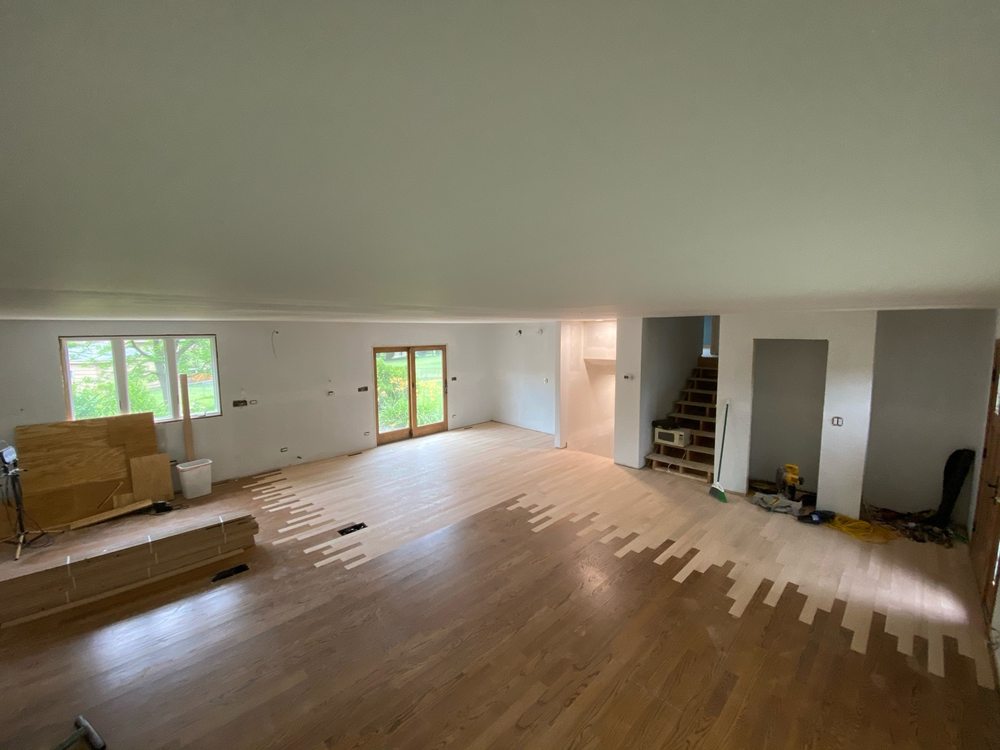
The good news is that buckling rarely means the whole floor. The lifted boards come out, the subfloor gets dried and metered, and new boards are woven into the sound wood along a staggered edge so there is no straight seam anywhere. The whole area is then sanded and finished as one piece, which is what makes the repair disappear. This is the core of what we do on floor repair jobs, and it is a fraction of the cost of a new floor.
New boards laced into an existing floor along a staggered edge, photographed before sanding. That ragged line is deliberate: a straight seam would always read as a patch, while a staggered one disappears completely once the whole area is sanded and finished together.
The moisture sources people miss
When we are standing on a cupped floor, this is the list we work through. It is worth walking yourself before the appointment, because you know your house better than we do.
Slow appliance and plumbing leaks
The classic is a refrigerator ice-maker line or a dishwasher that has been weeping a small amount for months. Nothing ever pools, nobody ever sees water, and the only symptom is a patch of cupped boards in front of the appliance. Bathrooms are the other repeat offender — a toilet flange or a tub surround leaking behind the wall shows up first as cupping at the doorway or in the room below.
Below-grade and crawl space moisture
Any wood floor over a crawl space or a slab depends on what is happening underneath it. An unsealed crawl space in a humid August pushes a lot of vapor into the underside of a first floor. A basement that stays damp does the same to the floor above. Sump pump failures and heavy-rain seepage are the acute version. If your cupping is worst on the level directly above an unconditioned space, look down before you look anywhere else.
New construction and wet trades
Floors installed in a house that still has drying concrete, fresh drywall mud, or fresh paint in it are absorbing that moisture as it leaves the building. This is a real cause of cupping in the first year of a new build or a big renovation, and it is one of several reasons acclimation matters — we go into that in more detail in our installation cost guide.
HVAC that is not doing what you think
A humidifier left on the furnace through spring keeps adding moisture into warming weather. An oversized air conditioner cools the house so fast it never runs long enough to dehumidify. A dehumidifier with a full bucket has been off for three weeks. None of these are dramatic, and all of them will move a floor.
A five-minute check before you call anybody
You can get most of the way to an answer with a $12 hygrometer and a flashlight:
1
Measure the room, do not guess it
Put a hygrometer on the main floor and read it over a week. If you are at 60% in August or 18% in January, you have found most of your answer already.
2
Map where it is happening
Walk the whole level with light raking low across the floor. Whole level, or one patch? Note what is above and below that patch — appliance, bathroom, exterior wall, crawl space.
3
Check the obvious water first
Pull the refrigerator out. Look under the dishwasher and the sink. Check the water heater pan and the sump. Most found leaks are found in this step.
4
Look underneath if you can
From the basement or crawl space, look at the underside of the subfloor below the affected area. Staining, dampness or a musty smell narrows it down fast.
5
Photograph it and date the photos
Take the same shot every couple of weeks. Whether the problem is improving, stable or worsening is the single most useful thing you can tell us, and it decides whether the floor gets sanded now or in three months.
What each fix actually costs
Costs depend entirely on what is wrong and how much of the floor it touches, but here is the general shape of it for the western suburbs:
Situation
What it takes
Typical range
Seasonal winter gaps
Nothing structural — add humidity in winter and let the floor close on its own
$0
Permanent gaps
Fill and refinish, or lace in boards where the gaps are wide
$3–$8/sq ft
Mild cupping, source fixed
Dry, monitor, then sand and refinish once meter readings are stable
$3–$8/sq ft
Severe or permanent cupping
Replace the affected boards, then sand and finish the area as one
$100–$350/board + refinishing
Crowning
Sand flat — but only after moisture readings have been stable for months
$3–$8/sq ft
Buckled section after a leak
Remove boards, dry and meter the subfloor, weave in new wood, refinish the area
By the job
Market ranges for DuPage, Will, and Kane County — not a quote, and not our price list. Board replacement in particular varies enormously with species, board width, and how hard the existing floor is to match. Our refinishing cost guide breaks the sanding side of these numbers down properly.
One number worth internalizing: a whole-house humidifier costs a great deal less than sanding a floor, and vastly less than replacing one. Of everything in this article, humidity control is the cheapest intervention by an order of magnitude.
Keeping a floor stable year-round
Winter, roughly November through March
This is the season that opens gaps, and the fix is to put moisture back into the air. A whole-house humidifier on the furnace is the reliable answer because it treats the whole house rather than one room; portable units help in a single space but rarely move a whole floor. Aim for the low end of the 30–50% band rather than the high end — pushing hard toward 50% in a cold snap can condense water on windows and inside exterior walls, which trades one problem for a worse one.
Summer, roughly June through September
This is the season that cups floors, and the fix is removing moisture. Air conditioning does most of it as a side effect of cooling, which is why cupping so often shows up during a mild humid stretch when nobody has the AC on. A basement dehumidifier is worth its price on any house with wood floors over a basement or crawl space — and worth checking that it is actually still running.
The small things that matter more than they look
Rugs slow the top of the floor from drying and can hold a cupped patch cupped for months. Take them up while a floor is recovering.
Sun dries the boards it falls on faster than the rest of the room. Blinds or sheers on a big south or west exposure even out both moisture and color change.
Wet mopping is the most common self-inflicted cause of mild cupping we see. Damp, well wrung out, wood-floor cleaner only — never a bucket, never a steam mop.
Mats at exterior doors catch the winter mix of snowmelt and salt, which is hard on finish and pulls water straight into the seams.
Leaving the house unconditioned for a long vacation in July is a classic way to come home to a cupped floor. Set the thermostat rather than turning it off.
What actually happens on a service call
When we come out for movement rather than for wear, the visit looks different from a refinishing estimate. We are diagnosing, not measuring square footage.
We meter the wood and the subfloor rather than eyeballing them, in the affected area and in an unaffected area for comparison, because the difference between the two readings is the real information. We look underneath wherever access exists. We check the obvious water sources. We ask how long it has been happening and what the house was doing at the time — the vacation, the leak, the new dishwasher, the year the basement flooded.
And often we recommend doing nothing yet. If the numbers say the wood is still wet, the right advice is to control the moisture and re-meter in six to eight weeks. That is not us avoiding work; it is the only sequence that ends with a flat floor. When the readings finally come back in range, sanding and refinishing takes a floor that looked ruined in August and makes it new again — you can see how far that goes in our project gallery.
Old houses and 1990s subdivisions behave differently
The housing stock out here splits fairly cleanly, and the split predicts the problems.
Older homes near downtown Naperville and in the established parts of Wheaton, Geneva and St. Charles typically have narrow strip oak over plank subfloors, often original, frequently sanded once or twice already. These floors have lived through eighty or ninety Illinois winters and their seasonal gapping is usually well established and entirely benign. What we watch for in them is thickness — a floor that has already been sanded several times has less material left to correct with — and crawl spaces, which many of these houses have and which drive most of their cupping.
The subdivisions built through the 1990s and 2000s across Plainfield, Oswego, Bolingbrook and Romeoville are a different animal: plywood or OSB subfloors, full basements, and floors that are usually still on their first finish. Movement problems there tend to trace back to the mechanical systems and the basement rather than to the building envelope — humidifiers left running into spring, oversized air conditioning that never dehumidifies, and sump or seepage events after heavy rain.
We work across all sixteen of these towns, and a movement call is worth making early. Cupping caught in its first month is a drying problem. Cupping ignored for a year is a board replacement problem.
Does engineered hardwood move less?
Yes, and it is one of the strongest arguments for it in specific places. An engineered board's plywood core runs its plies in alternating grain directions, so the board is dimensionally far more stable across its width than a solid board of the same size. That is exactly why engineered is the right call over concrete, over radiant heat, and anywhere below grade.
Two caveats keep it honest. Engineered is not immune — put enough moisture underneath it and it will cup too, and a thin-veneer product can delaminate rather than simply deform. And when an engineered floor does have a problem, you have far less material to sand it out with: a 4–6mm wear layer gives you a sanding or two, while a 2mm veneer gives you a screen and recoat at best. Solid hardwood moves more, but a ¾-inch solid floor gives you five to eight sandings across its life to fix whatever happens to it.
In a typical western-suburb house, that usually resolves to solid on the main floor and upstairs, engineered below grade — which is the same recommendation we would give on a new installation, for the same reasons.
Floor doing something you do not like?
We will come out anywhere in DuPage, Will or Kane County, meter the wood and the subfloor, tell you what is causing it, and tell you honestly whether it needs work now or in three months. No obligation either way.
Usually, yes. Wood gives up moisture when the air around it is dry, and a heated Illinois house in January is very dry. Thin, even gaps that appear across a whole room in winter and close again by midsummer are the floor doing exactly what wood does. The gaps worth a second look are the ones that stay open all year, the ones that are much wider in one part of the room than another, or gaps wide enough to catch a dime that never close at all. Those point at a moisture problem, a fastening problem, or a floor that was installed too dry, and none of the three fixes itself.
Cupping means the edges of each board sit higher than the middle, and it happens when the underside of the floor is wetter than the top. In a western-suburb house the usual causes are a humid stretch with the air conditioning off, a slow appliance or plumbing leak, moisture coming up through a slab or crawl space, or a basement that stays damp. Mild seasonal cupping in August often relaxes on its own once the house dries out. Cupping that keeps getting worse, or that is concentrated in one area near an appliance or an exterior wall, is a leak until proven otherwise.
Often, but only after the moisture source is gone and the wood has come back to a normal moisture content. That takes weeks, not days, and sometimes a full season. Running the air conditioning or a dehumidifier speeds it up; fans alone mostly move air around. If the boards are still cupped after the house has been dry for a couple of months, the shape is likely permanent and the floor needs sanding or, where the boards have crushed against each other at the edges, board replacement.
Not while it is still wet, and this is the mistake that turns a repairable floor into a ruined one. Sanding a cupped floor removes the raised edges. When the wood finally dries and the boards relax, those sanded edges end up lower than the centers, and you are left with a crowned floor — the opposite defect, and a much harder one to correct. The correct order is always: find the moisture, stop it, dry the floor, meter the boards, and only then sand.
The National Wood Flooring Association calls for 60–80°F and 30–50% relative humidity year-round. That is the range wood flooring is manufactured and installed to live in. In practice, holding it in the Chicago area means adding moisture in winter — a whole-house humidifier on the furnace is the reliable way — and removing it in summer with air conditioning or a dehumidifier, especially below grade. An inexpensive hygrometer on the main floor tells you whether you are actually in range instead of guessing.
All three are the same physics at different severities. Cupping is edges high and center low, caused by more moisture underneath than on top. Crowning is the reverse, center high and edges low, and it usually follows either a cupped floor that was sanded too early or a floor that dried from the top down. Buckling is the extreme case: the floor takes on so much moisture that it has nowhere left to expand and lifts away from the subfloor entirely. Cupping and crowning are usually repairable. Buckling almost always means boards are coming out.
Rarely. The lifted boards have to come out, and the subfloor underneath has to be dried and metered before anything goes back down, but the sound wood around it usually stays. New boards are woven into the existing floor along a staggered edge so there is no straight seam, then the whole area is sanded and finished as one piece so the repair disappears. Replacing a section this way is dramatically cheaper than a new floor. The part that cannot be rushed is the drying — laying new wood over a wet subfloor guarantees a second failure.
Yes, generally. An engineered board's plywood core runs its layers in alternating directions, so the board moves far less across its width when humidity swings. That is exactly why engineered is the better choice over concrete, over radiant heat, and below grade. It is not immune, though — a thin-veneer engineered floor can still cup, and it has far less thickness available to sand a problem out afterward. Solid hardwood moves more, but it also gives you five to eight sandings to fix things over its life.