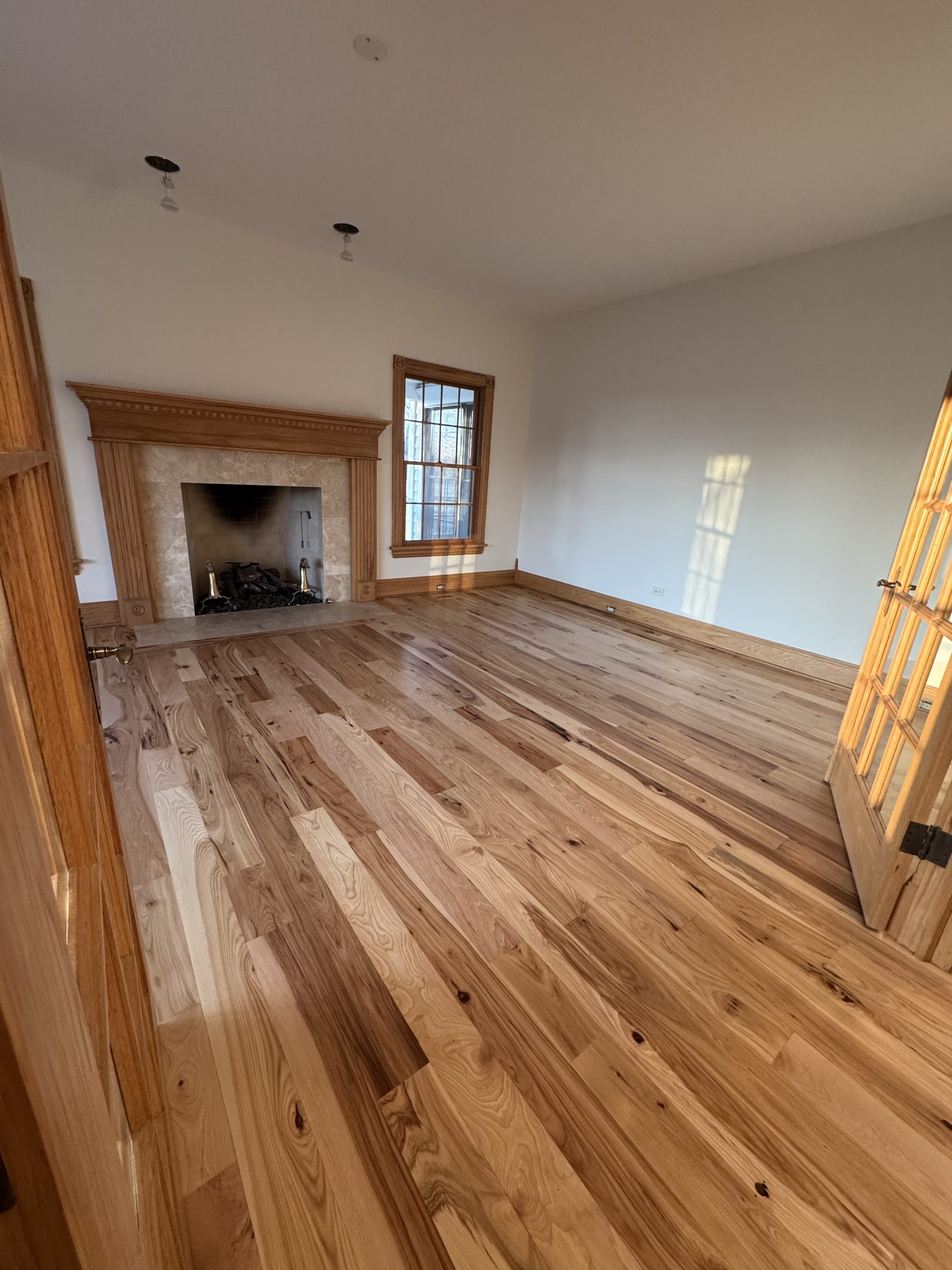
Choosing New Floors for Will County Homes: Joliet, Plainfield, Bolingbrook and Romeoville
Will County houses are not all built the same way, and the floor that suits a 1920s Joliet bungalow is often the wrong pick for a 2005 Plainfield two-story. Here is how we match hardwood, luxury vinyl plank and laminate to the homes we work in across Joliet, Plainfield, Bolingbrook and Romeoville, room by room, and when repairing or refinishing beats replacing.
The short answer
Start with what the floor will sit on, then the room, then the household.
Wood subfloors over crawlspaces and basements can take solid or engineered hardwood once moisture and flatness check out. Concrete slabs and basements usually call for engineered hardwood, LVP or laminate rather than solid wood. Kitchens, baths, mudrooms and laundry rooms favor water-resistant LVP. And if you already have hardwood, repair or refinishing is often the better buy than tearing it out.
In this guide
Why Will County houses differ
Most of the flooring decisions we help with in Will County come down to two questions homeowners rarely think to ask: what is under the current floor, and how does the house handle moisture through an Illinois year? The answers change a lot from one part of the county to another.
Older neighborhoods, especially in Joliet, tend to have wood plank subfloors over crawlspaces or unfinished basements. Newer subdivisions in Plainfield, Bolingbrook and Romeoville are more often built on plywood or OSB decks over full basements, with some rooms, and many finished lower levels, sitting directly on concrete. Each of those bases accepts some floors well and others badly. Getting that match right does more for how a floor looks in five years than any brand or color choice.
Older Joliet homes
If you are planning new flooring in Joliet, IL, there is a good chance the house is older than most of what surrounds Naperville. Many of these homes have original hardwood hiding under carpet, sometimes in better shape than the owners expect. Before anyone talks about replacing it, it is worth pulling up a corner and looking.
When a new floor does make sense, the plank subfloor is the first thing we check. Old boards can be cupped, loose or uneven, and a crawlspace below can feed moisture up into the floor if it is damp or poorly vented. Solid hardwood is often a good fit once the subfloor is flattened and fastened and the moisture readings are in range. Engineered hardwood is a strong choice where a crawlspace runs damp or where a room has had water trouble before. Our guide to subfloor and moisture prep walks through those checks in detail.
Older houses also tend to have more transitions: thresholds between rooms, floors at slightly different heights, and stairs that need to match. Planning those details up front avoids awkward ramps and reducers later.
Plainfield, Bolingbrook and Romeoville subdivisions
Homes in the newer subdivisions usually have flatter, more uniform subfloors, which opens up every product type. The catch is concrete. Finished basements, and in some homes the main living level, sit on a slab, and a slab gives off moisture vapor whether or not it has ever flooded. Solid hardwood should not go directly on concrete below grade. Engineered hardwood, LVP and laminate can, with the right moisture testing and underlayment.
For flooring in Plainfield, we often see families replacing builder-grade carpet and vinyl with one continuous floor across the main level. That works well, but long open runs need attention to expansion space and flatness, especially with long LVP planks that show every dip.
For hardwood flooring in Bolingbrook, a common project is refreshing 1980s and 1990s oak that has gone orange and worn in the traffic lanes, while adding matching wood to rooms that were carpeted. For flooring in Romeoville, the newer homes often pair hardwood or engineered wood upstairs with LVP in the basement and mudroom.
Which floor suits which room
- Living rooms, dining rooms and bedrooms: solid or engineered hardwood is the classic choice, can be refinished later, and suits both older and newer homes when the subfloor is wood.
- Kitchens: hardwood works in many kitchens if spills get wiped up, but households that want a worry-free floor near the sink and dishwasher often choose LVP.
- Bathrooms, laundry rooms and mudrooms: water-resistant LVP is usually the practical pick. Laminate is improving, but standing water is still its weak point.
- Basements: LVP or engineered hardwood over a tested slab, never solid hardwood. Our basement flooring guide goes deeper.
- Stairs: hardwood treads match a wood main floor and outlast carpet. Matching stairs to LVP takes specific nosings and is worth planning early.
If you are weighing the two most common options for a main level, our comparison of vinyl plank vs. hardwood covers durability, feel, sound and long-term value side by side.
Kids, pets and busy entries
Every floor scratches eventually. The question is whether you can live with it and whether it can be renewed. Hardwood shows scratches from pets and furniture, but a lower-sheen finish hides them well, and the whole surface can be screened and recoated or refinished years later. LVP resists scratches and water better day to day, but a badly damaged plank has to be replaced rather than sanded. Laminate is hard-wearing on the surface but does not like standing water at the seams.
For busy households, a mixed plan often works best: hardwood where the family lives and LVP where boots, bowls and laundry go. One continuous look across rooms is possible by choosing tones that sit well together and planning the transitions in advance.
What installation involves
A good installation is mostly preparation. The old floor comes up, the subfloor is inspected, loose areas are fastened, high and low spots are corrected, and moisture is tested on wood and concrete. Solid hardwood is brought into the house ahead of time so it can adjust to indoor conditions. Then the floor goes down with the right expansion gaps, transitions and trim. On older Joliet homes with plank subfloors, the prep step can take longer than the install itself, which is normal and worth doing properly.
For a straight answer on scope and timing, the most reliable step is an in-home look from a flooring contractor in Naperville who works the whole western suburbs, including Will County.
When repair or refinishing beats replacing
Plenty of Will County homes do not need new floors at all. If you have solid hardwood with scratches, worn traffic lanes, an outdated stain color or a few damaged boards, hardwood floor refinishing can bring it back for far less disruption than a tear-out. Isolated water stains, loose boards and pet damage can often be handled with hardwood floor repair, by weaving in matching boards before the floor is sanded.
That is especially true of hardwood flooring in Joliet homes, where original oak and maple floors often have plenty of wear layer left. Replacement makes more sense when the floor has been sanded too many times, has widespread water damage, or is a product that cannot be refinished.
What we look at on the estimate
When we visit, we look at more than square footage. Expect us to check what the floor sits on, take moisture readings, look at flatness and squeaks, note transitions and stairs, and talk through how each room is used. If you already have hardwood under carpet or a worn finish, we will tell you honestly whether it is worth saving. Then you get a clear recommendation for each room, not a one-product sales pitch.
Planning floors for a Will County home?
We will check what your floors sit on, tell you which products suit each room, and let you know if your existing hardwood is worth saving. Free in-home estimates across Joliet, Plainfield, Bolingbrook, Romeoville and the rest of DuPage, Will and Kane County.
Will County Flooring Questions
Often, yes. Many older Joliet homes have original hardwood under carpet. Lifting a corner in a closet or at a floor vent usually tells you. If it is there, refinishing is often a better buy than new flooring.
Solid hardwood should not go directly on a basement slab. Engineered hardwood, luxury vinyl plank or laminate can, after the slab is tested for moisture and the right underlayment is chosen.
Water-resistant luxury vinyl plank is usually the practical choice for mudrooms, laundry rooms and bathrooms, because it handles wet boots, spills and appliance leaks better than hardwood or laminate.
Yes, in most homes, as long as the subfloor is flat and the layout leaves proper expansion space. In some homes we pair hardwood in the living areas with matching-toned LVP in wet rooms instead.