Luxury vinyl plank and hardwood are not really competing for the same rooms. One is built to survive water and wet boots; the other is built to be sanded and made new for decades. The right answer for most western-suburb houses uses both.
Updated September 17, 2026·15 min read·By Angel Hardwood Floor Corp
The short answer
Pick by room, not by house. Hardwood is the better floor for the rooms people live in on the main and upper levels — living, dining, bedrooms, hallways and, with some care, the kitchen — because it can be sanded and made new again for decades. Luxury vinyl plank is the better floor wherever water is a regular visitor: the basement, the mudroom, the laundry room, full bathrooms. It shrugs off spills and wet boots, and when it wears out it gets replaced rather than refinished.
Most of the regret we see comes from applying one answer to the whole house — vinyl laid through a living room where a wood floor would have outlasted it three times over, or oak run into a mudroom that takes a February’s worth of snowmelt every afternoon.
Nearly every flooring estimate we give in the western suburbs includes some version of the same question: “Should we just do vinyl plank?” It is a fair question. Luxury vinyl has changed completely in fifteen years. The thin, floppy sheet goods people remember from their parents’ kitchens have been replaced by thick, rigid-core planks with a convincing wood grain printed on top, sold on every showroom display with the word waterproof in large type. Meanwhile hardwood costs more, takes longer to install, and does not like water.
We install both, so we do not have a horse in this race. What we have is the view from the other end of the decision — the calls that come in five, ten and twenty years after somebody chose. Homeowners in Naperville who put vinyl through a whole main floor and now want wood. Homeowners who put solid oak into a basement and are pulling it back out. And a great many who got it right, almost always by splitting the house between the two.
This guide goes through the decision the way we do on an estimate: what each material actually is, how each behaves in an Illinois house through a Chicago-area winter and a humid summer, what happens with dogs, kids and dishwashers, what each costs over its life rather than on day one, and how to put them next to each other without an ugly lip at the doorway. If you have already decided on vinyl and are working out where it goes, our basement flooring guide covers the below-grade side in more depth.
The names blur together on a showroom floor, so it is worth being precise about what is in the box.
Solid hardwood is one piece of wood, typically ¾ inch thick, milled with a tongue and groove and nailed or stapled to a wood subfloor. Red oak and white oak are the most common species in houses out here, with maple and hickory behind them. What you walk on is the same material all the way through.
Engineered hardwood is a real wood top layer bonded to a cross-ply core. It looks and feels like solid wood from above and behaves more stably underneath. It gets its own section below, because for some rooms it is the actual answer to this question.
Luxury vinyl plank (LVP) is a layered plastic product. On the rigid-core versions we install most, there is a dense core — SPC, stone-plastic composite, or the slightly softer WPC — a printed photographic layer that carries the wood look, and a clear wear layer on top that takes the traffic. Most of it clicks together and floats over an underlayment rather than being fastened down.
The single most important spec on vinyl is that clear wear layer, and it is measured in mils — thousandths of an inch. Residential planks are most commonly sold with a 12-mil or 20-mil wear layer, which works out to roughly 0.3 and 0.5 millimetres. Overall plank thickness, which is the number printed biggest on the box, tells you about feel underfoot. The wear layer tells you how the floor will look in ten years. Our vinyl flooring page covers the product formats in more detail.
Laminate is a third, different product. It looks similar to vinyl plank and floats the same way, but its core is compressed wood fibre, which swells permanently when it gets wet. Everything this guide says about vinyl handling water does not apply to laminate. If laminate is on your shortlist too, our laminate flooring page covers where it belongs and where it does not.
Water: where the gap is widest
This is the clearest difference between the two materials and it is the one that should drive the decision in half the rooms of a house.
A rigid-core vinyl plank has nothing in it for water to ruin. Spill a pot of pasta water on it, track in a slush puddle, let the dog’s bowl overflow — wipe it up and the plank is exactly as it was. Hardwood is the opposite. Standing water finds the seams between boards, the wood swells across its width, and the edges lift into a cup. A single spill wiped up promptly is not a problem for a well-finished wood floor. A slow, repeated one is.
Two cautions keep this from being as simple as the box makes it sound.
“Waterproof” means the plank, not the room. Vinyl warranties cover topical water — a spill from above. Water that gets under a floating floor at a wall, a doorway or a seam sits against the subfloor with nowhere to evaporate. The plank survives; the plywood or the underlayment underneath it may not. We go into what the warranties exclude in the basement guide.
Slow leaks hide longer under vinyl. A dishwasher supply line or a refrigerator ice-maker line that weeps for weeks announces itself on hardwood, because the boards cup where the water is. Under a waterproof floor the surface looks perfect while the subfloor underneath gets wet. Neither material is better here, exactly — one fails loudly and one fails quietly.
The practical result: in rooms where water is routine rather than accidental — mudrooms, laundry rooms, full bathrooms and basements — vinyl wins cleanly. In rooms where water is occasional, the real question becomes whether you would rather have a floor that tolerates it or a floor that can be repaired after it. If you have already had water on a wood floor, our floor repair guide covers what can be saved.
Illinois winters, summers and floor movement
Both floors move. They just respond to different things, and that decides where each one causes trouble.
Hardwood moves with humidity. Through a Chicago-area winter, forced-air heat dries the house out and boards shrink, opening thin gaps between them. Through a humid July, they take moisture back and close up — and if the house gets too damp, they cup. Most hardwood manufacturers recommend keeping indoor relative humidity roughly between 35% and 55%, which in practice means a humidifier in winter and air conditioning in summer. Seasonal gaps that open in January and close by May are normal wood behaviour, not a defect, and our guide to gaps and cupping explains where normal ends.
Vinyl moves with temperature. Humidity does almost nothing to a rigid-core plank, which is a genuine advantage in an unevenly conditioned room. Heat is another story. A floating vinyl floor in front of a big south- or west-facing slider, or in a sunroom that bakes in the afternoon, can expand enough to push against the walls, peak at the joints, or open gaps at the ends of planks when it cools again. Manufacturers publish temperature limits and expansion-gap requirements for exactly this reason, and some call for glue-down installation in rooms with heavy direct sun. The rule is the same as for wood: the gap at the wall is not optional, and it is why the trim has to be installed so the floor can move beneath it.
Put simply: a main-floor living room with steady heating and cooling suits either. A three-season room or an unconditioned space suits neither very well, and the manufacturer’s installation instructions — not the showroom sample — decide whether it is allowed at all.
Scratches, dents, dogs and kids
This is where most homeowners assume vinyl wins outright, and it mostly does — with more nuance than the marketing suggests.
Scratches. A good vinyl wear layer resists everyday scratching better than a site-applied polyurethane on wood. Dog nails, dragged chairs and sand on shoes all mark a wood finish sooner. The catch is what happens once a scratch goes through: on vinyl, a gouge that cuts past the wear layer exposes the printed image or the core, and there is no sanding it out. On hardwood, scratches that sit in the finish disappear at the next screen and recoat, and deeper ones come out with a full sand. Wood scratches sooner; vinyl scratches more permanently.
Dents. Hardwood dents under point loads — a dropped cast-iron pan, a high heel, the leg of a heavy dresser. How much depends on species: on the Janka hardness scale, red oak is about 1290, white oak about 1360, maple about 1450 and hickory about 1820, so a hickory floor forgives far more than a red oak one. Rigid-core vinyl resists small dents well, but thinner products can take a permanent impression under concentrated weight such as a piano or a loaded refrigerator dragged across it.
Dogs. For a household with a large, active dog, vinyl is the lower-stress floor day to day: it hides nail traffic better and pet accidents wipe off the surface rather than soaking into wood. On hardwood, urine that sits soaks into the fibres and turns them dark, and that kind of stain usually does not sand out — the boards get replaced. Vinyl is not immune either; liquid that works into the seams of a floating floor ends up on the subfloor. If you choose hardwood with a big dog, pick a harder species, a matte sheen that hides wear, and keep a box of boards back for repairs.
Kids. Toy trucks, spilled juice and a hockey stick in the kitchen favour vinyl while the children are small. The counter-argument is time: a family that plans to stay fifteen years will outlast the toddler phase, and a wood floor can be sanded back to new when they do. A vinyl floor that took fifteen years of hard wear is simply finished.
The difference that matters most: renewal
If you take one thing from this guide, make it this. Almost every other comparison between these two floors is about the first five years. This one is about the next fifty.
A hardwood floor can be made new again. A ¾-inch solid floor can realistically be fully sanded and refinished five to eight times over its life, and lighter screen-and-recoat maintenance can be done far more often than that. Each full sand takes it back to bare wood and lets you change the colour completely — from the orange oak of the 1990s to a natural or a pale grey. The floor in the photo below will look like that again in 2050 if someone sands it. Our refinishing cost guide covers what that costs when the time comes, and the finishes guide covers what goes on top.
A vinyl floor cannot. The look is a printed layer under a thin clear coat. When that coat is worn through in the traffic lanes, or the style has dated, or a section is badly damaged, the floor is replaced. Individual planks can be swapped, which is a real advantage for isolated damage — but on a click-together floor a plank in the middle of the room means either unclicking rows from the nearest wall or cutting the damaged plank out and gluing in a replacement, and either way you need spare planks from the same production run. Buy extra boxes on day one and keep them.
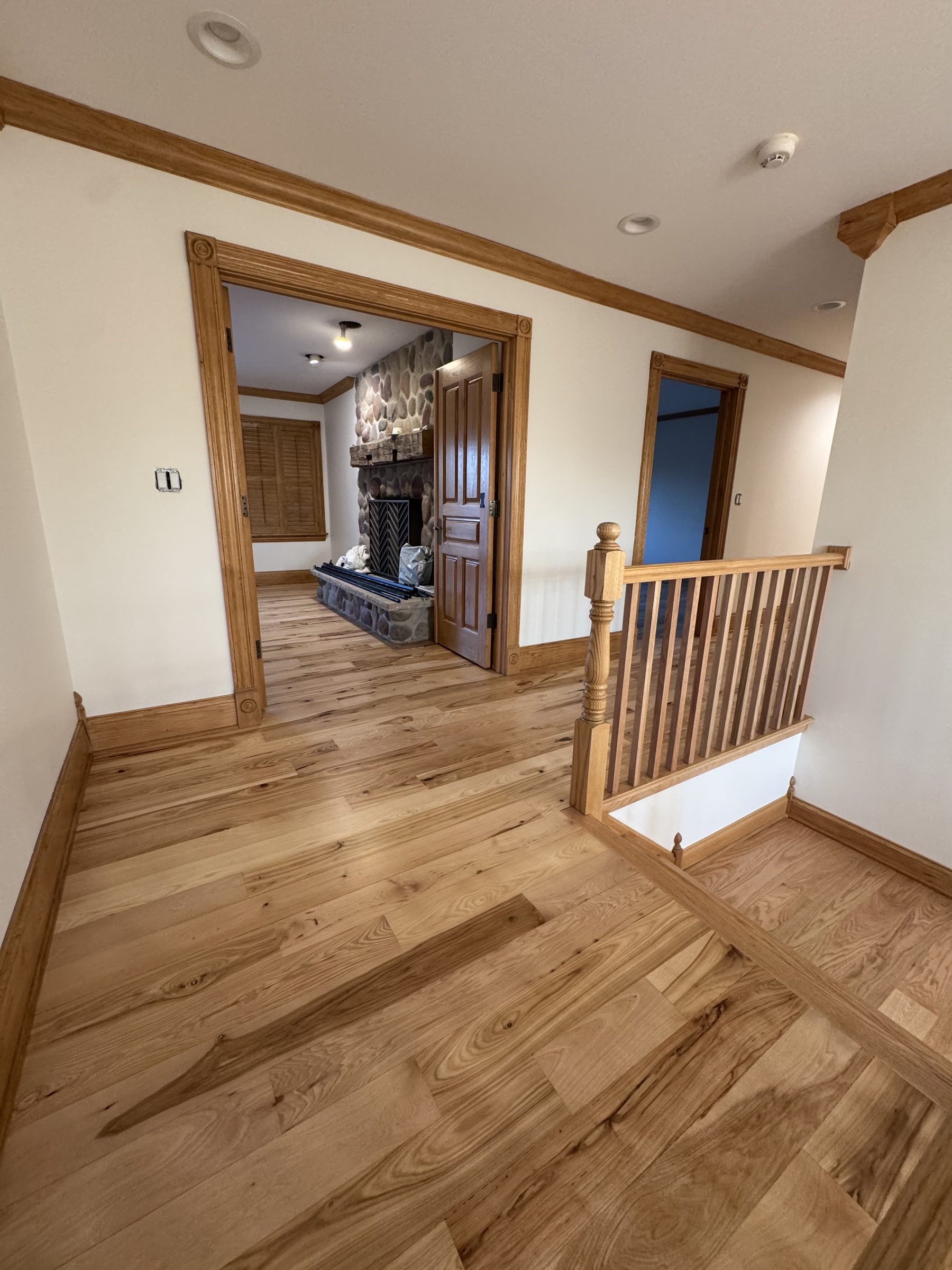
Wide-plank natural hickory carried through an upper hallway and into the next room. A solid wood floor like this can be sanded back to bare wood several times over its life — the one thing no vinyl plank can offer. More of this project is in our project gallery.
Look, feel and sound
Good vinyl is convincing at a glance and in photographs. It is less convincing in person, in a big room, over time.
Pattern repeat. Every vinyl plank is a print, and each product line has a limited number of distinct plank images. In a closet or a laundry room nobody notices. Across an open 600-square-foot living and dining area, the same knot turning up every few feet is what gives it away. Before you buy, ask how many unique plank visuals the line has and lay out a dozen loose planks together.
Raking light. Low winter sun across a floor shows texture. Embossed vinyl imitates grain; real wood has it. It is the moment most people can tell the difference.
Feel underfoot. Nailed-down hardwood feels solid and slightly warm. Floating vinyl over a good underlayment feels firm but reads differently, and over a subfloor that was not properly flattened it clicks and sounds hollow in spots. Most of that is installation, not product — which is why subfloor prep matters so much with vinyl.
Sound. Floating floors transmit a sharper footstep sound through the room than nailed wood. Underlayment helps. In a condominium or high-rise building, check the association’s sound-transmission rules before ordering either material; some buildings specify a minimum rated underlayment.
Colour change. Wood ages: oak ambers under an oil-based finish, cherry darkens, and rugs leave lighter patches for a while. Vinyl barely changes colour at all. Whether that is an advantage depends on whether you like the colour you started with.
Cost on day one
Vinyl is cheaper to put down. How much cheaper is smaller than many people expect once the whole job is priced.
Using the market ranges in our hardwood installation cost guide for DuPage, Will and Kane County, luxury vinyl plank runs roughly $5–$11 per square foot installed, while prefinished engineered hardwood runs roughly $7–$15 and prefinished solid hardwood roughly $8–$17. Those bands overlap. A premium vinyl with a thick wear layer and a good underlayment can cost as much as an entry-level engineered wood floor, and it is worth pricing both before assuming the gap is large.
Three things tend to narrow the difference further on a real job:
The prep is the same. Tearing out carpet or old tile, flattening the subfloor, dealing with transitions and replacing baseboard cost much the same whichever floor goes down. Vinyl is actually more demanding about flatness, because rigid planks bridge low spots instead of following them.
Labour is a smaller share of the gap than material. A floating vinyl install is faster than nailing wood, but not dramatically so once cuts, doorways and stairs are counted.
Stairs cost what stairs cost. Vinyl stair nosings and treads are fiddly to do well, and on a staircase the saving over hardwood treads is often modest.
All ranges are general market figures for the western suburbs — not a quote and not our price list. Your number depends on the product, the rooms and what is underneath.
Cost over the life of the floor
The honest way to compare them is per year of service, not per square foot on the invoice.
A vinyl floor is bought once and replaced once it is worn or dated, and replacement means tearing out and paying again for material, labour and disposal. A solid hardwood floor is bought once and then periodically refinished — a job that costs a fraction of new installation and resets the floor’s appearance entirely. Over two or three decades in the same house, those two patterns diverge sharply. For a family that intends to stay, hardwood in the main living areas usually ends up the cheaper floor, even though it was the more expensive one to install.
The picture flips for shorter horizons. If you are planning to sell within a few years, or the floor is in a rental, or it is in a room where water will eventually win — the basement that has already had a sump pump fail once — the lower upfront cost and the replaceability of vinyl make more sense than paying for a lifespan you will never use.
Resale in a western-suburb market
We are careful here, because resale claims are where flooring marketing gets loose with numbers.
What can be said with a source: in the National Association of REALTORS® 2022 Remodeling Impact Report, a national survey, REALTORS® estimated that refinishing hardwood floors recovered about 147% of its cost at resale and that new wood flooring recovered about 118% — the two highest cost-recovery figures among the interior projects in that edition. The report did not break out luxury vinyl. Those are national estimates rather than a Naperville appraisal, and they are several years old, but they are consistent with what agents describe: buyers notice hardwood.
The local reasoning is simpler than the statistics. In much of Naperville and the surrounding towns, the comparable houses a buyer walks through on the same Saturday already have oak on the main floor. A listing with vinyl through the living and dining rooms is being compared against those, and against the refinishing quote the buyer imagines getting for the oak down the street. Vinyl in a basement, mudroom or laundry room raises no such comparison — buyers expect it there and increasingly prefer it.
Refinishing is the cheapest move of all if you already have wood. If there is tired hardwood under carpet or showing wear in the traffic lanes, putting vinyl over it spends money to cover the thing buyers value. Refinishing it usually costs less than new vinyl, and it is the project with the strongest cost-recovery figure in that report. Our floor restoration page explains what the process involves.
Room by room
This is how the decision usually resolves once a house is walked through room by room.
Living room, dining room, bedrooms, hallways
Hardwood, for almost every household. These rooms rarely see water, they carry the look of the house, and they are where the refinishing advantage pays off. The exception is a household that prioritises low maintenance above everything and does not plan to stay long.
Kitchen
Genuinely either, and the most debated room in the house. Hardwood in a kitchen is common and works well with sensible habits: wipe spills, use mats at the sink and dishwasher, and watch the supply lines. It also lets the wood run continuously from the kitchen into the family room, which is the look most open-plan houses are built around. Vinyl is the lower-worry choice for a busy family kitchen, with the caveat about slow leaks hiding underneath. If the kitchen opens straight into wood-floored rooms, we usually lean hardwood for continuity.
Mudroom, laundry room, back entry
Vinyl, clearly. These are the rooms where boots come off in January, snowmelt and ice-melt residue sit on the floor, the washer lives, and the dog comes in wet. Grit and de-icing residue dull a wood finish quickly, and water is routine rather than occasional.
Bathrooms
Vinyl, or tile, in full bathrooms with a tub or shower — the standing water and humidity in front of a shower are hard on wood. A powder room with no bathing can go either way, and running the hallway’s hardwood into it is often the better look.
Basement
Rigid-core vinyl in most basements, engineered wood in a dry, tested one, and solid hardwood never. That decision has enough to it that it has its own guide: basement flooring in Naperville.
Stairs
Usually match the floor the staircase lands on. Vinyl stair nosings exist and can look good, but on an open-sided staircase with an oak railing the wood treads almost always look more at home. Our stairs guide covers the options once the carpet comes up.
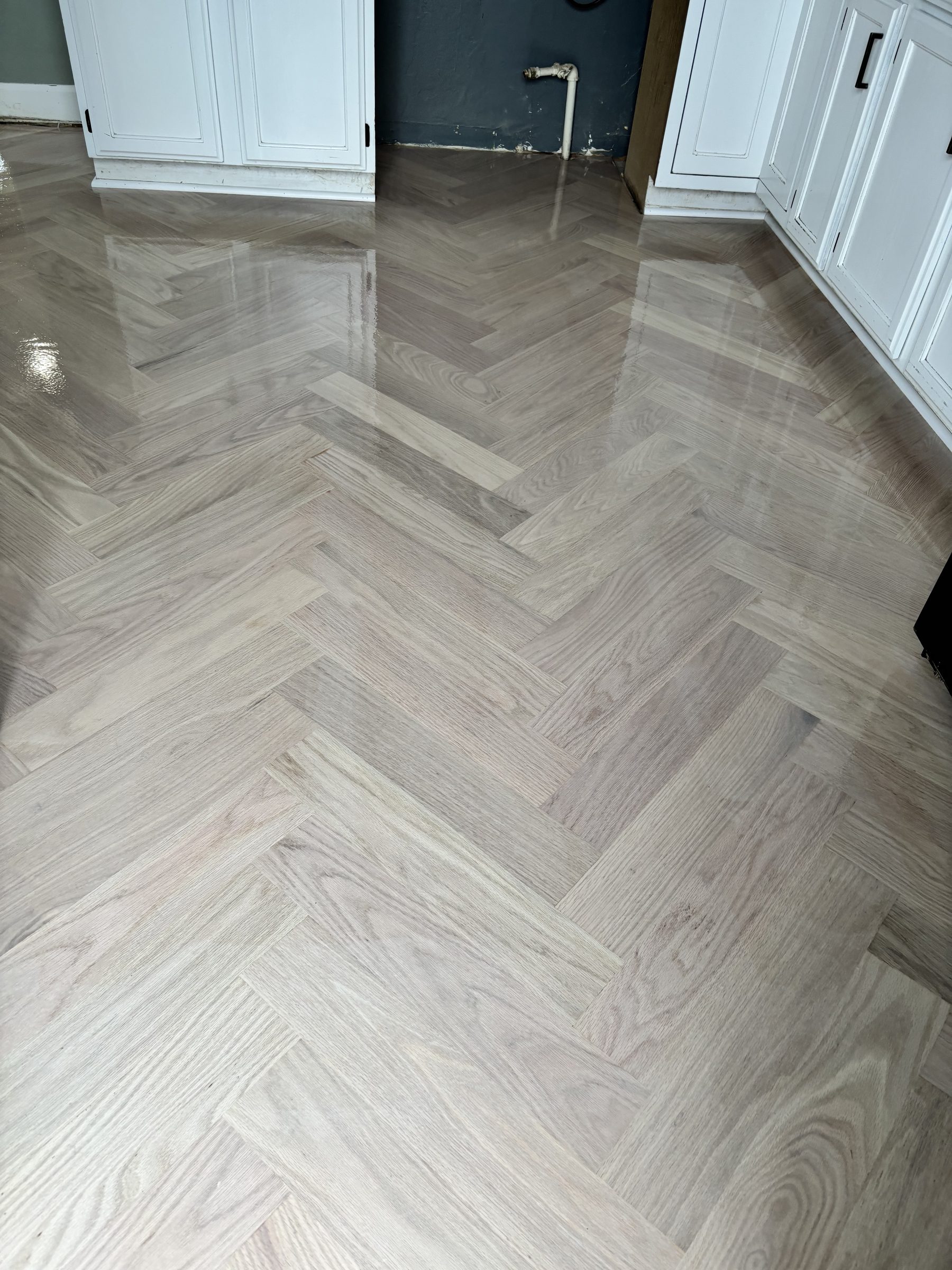
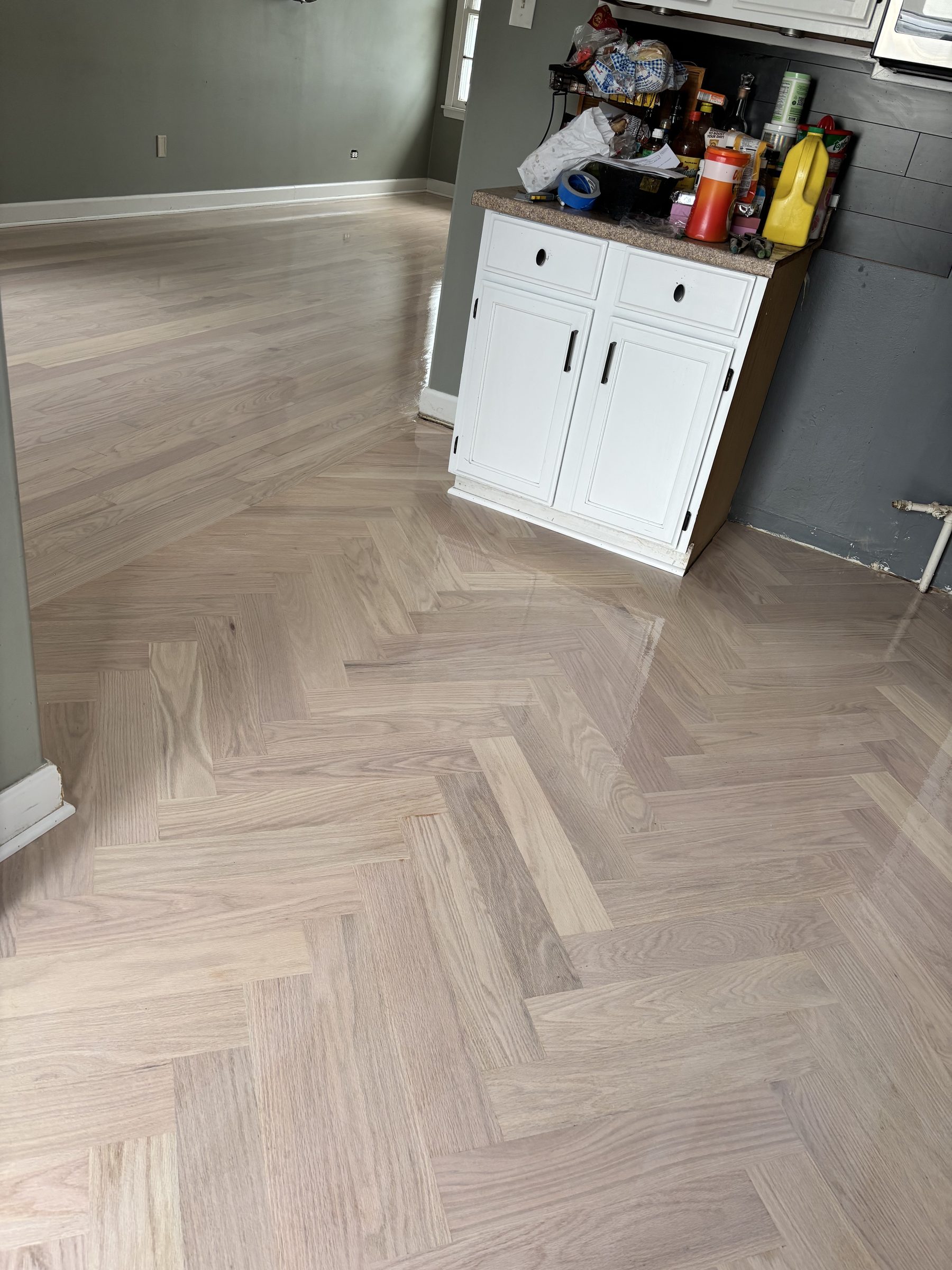
A kitchen laid in oak herringbone, meeting straight-laid oak in the next room. Keeping real wood in a kitchen that opens onto wood-floored rooms is what lets the whole level read as one floor — a choice worth weighing against vinyl’s easier care.
Engineered hardwood: the middle option
A lot of “vinyl or hardwood?” conversations end at engineered hardwood instead, and for good reason.
Engineered flooring has a real wood surface over a plywood core whose layers run in alternating directions, so it moves much less with humidity than solid wood. That makes it suitable in places solid hardwood is not — over a concrete slab, over radiant floor heat, in a dry below-grade room, and in condominium buildings with concrete decks. Above the subfloor it looks and feels like wood, because it is.
The limit is the thickness of that wood surface. A product with a 4–6 mm wear layer can typically be sanded one to three times; one with a 2 mm layer can take a light recoat at best and, in practice, behaves more like vinyl over its lifetime — replaced rather than renewed. If you go engineered, get the wear-layer thickness in writing. It is the number that decides whether you bought a wood floor or a wood-look floor with a real-wood skin. Our hardwood flooring page compares solid and engineered in more detail.
It is still not a waterproof floor. A mudroom or a full bathroom is vinyl territory whether the wood on top is solid or engineered.
Putting both in one house
Most good outcomes use both materials, so the joins deserve as much thought as the materials themselves.
Plan the height difference. Solid hardwood is ¾ inch — about 19 mm — while the rigid-core vinyl we most often recommend runs roughly 8–12 mm. Put them side by side over the same subfloor and there is a step at the doorway. That gets handled with a reducer or transition moulding, or by building up the subfloor under the thinner floor. It should be in the quote, not discovered on install day.
Change materials at a doorway, not in the middle of a room. A transition across an open floor plan reads as a mistake. A transition at a door frame, a change in ceiling height, or the top of the basement stairs reads as intentional.
Choose tone relationships, not matches. A vinyl plank that tries to match your oak exactly will look slightly wrong next to it forever. A vinyl in a clearly different tone — a greyer or darker plank in the mudroom next to natural oak — looks like a decision.
Mind the expansion gaps at the join. Both floors need room to move, in different seasons and for different reasons. A transition that pins one floor against the other defeats the gaps at both.
Our floor installation page walks through how we handle subfloor prep and transitions on mixed-material jobs.
Vinyl over existing hardwood
We get asked this regularly, usually by someone with a worn oak floor and a quote for vinyl that is cheaper than they expected refinishing to be.
Technically, a floating vinyl floor can often go over an existing hardwood floor if the wood is flat, firmly fastened and not moving with the seasons. Practically, it is rarely the right call. You lose headroom at doors and at the stairs, you create height transitions at every room where the vinyl stops, and you permanently hide the one floor in the house that could have been made new with a sander. If the oak is cupped, loose or gapping badly, those problems will telegraph through a thin floating floor anyway.
Before covering hardwood, get a refinishing price. In most houses it is the better and often the cheaper answer.
Side by side
Factor
Solid hardwood
Engineered hardwood
Rigid-core vinyl plank
Water
Cups and swells with standing water
More stable, still wood — not for wet rooms
Plank unaffectedBest; subfloor still vulnerable
What moves it
Humidity — winter gaps, summer cupping
Humidity, much less than solid
Temperature and direct sun
Surface scratches
Shows sooner; sands out
Shows sooner; limited sanding
Resists longer; deep ones are permanent
Renewal
Full sand many timesBest
1–3 sandings on a thick wear layer
None — replace planks or the floor
Installed cost range
~$8–$17 / sq ft prefinished
~$7–$15 / sq ft
~$5–$11 / sq ft
Over concrete / radiant heat
Generally no
Yes, within product limits
Yes, within product limits
Best rooms
Living, dining, bedrooms, halls, kitchen
Same, plus slab and radiant-heat areas
Basement, mudroom, laundry, full baths
General material behaviour and western-suburb market ranges — not a quote, and not a substitute for the installation instructions of the specific product you choose.
Two kinds of house, two answers
Across the towns we serve in DuPage, Will and Kane County — the full list is on our service area page — the decision tends to follow the age of the house.
The older house with wood already in it. In Wheaton, Downers Grove, Geneva, St. Charles and the older neighbourhoods of Naperville, there is very often oak under the carpet or already exposed and worn. Here the question is rarely vinyl versus new hardwood. It is vinyl versus refinishing what is already there, and refinishing usually wins everywhere except the kitchen back door, the laundry and the basement. The mistake to avoid is covering good wood.
The newer house with carpet and builder-grade finishes. Across the later subdivisions in south Naperville, Plainfield, Oswego, Aurora and Bolingbrook, a lot of houses were built with carpet in the living areas, sheet vinyl or tile in the kitchen and baths, and an unfinished or lightly finished basement. These owners are choosing from scratch, and the split we most often recommend is new hardwood or engineered wood through the main living level, rigid-core vinyl in the basement, mudroom and laundry, and a deliberate transition at the doorways between them.
What we ask before recommending either
On an estimate we will not recommend a material until we know the answers to these:
Which rooms, and what happens in each — where the water is, where the dog comes in, where the boots come off.
How long you plan to stay, because it changes the lifetime-cost answer more than anything else.
What is on the floor now, and what is under it — especially whether there is hardwood under the carpet.
What the subfloor is: wood framing, a concrete slab, or radiant heat.
How flat that subfloor is, since vinyl is less forgiving of dips than people expect.
How much direct sun hits the floor through big windows or sliders.
What the neighbouring floors are, and where a transition could sit naturally.
Whether the house is heated and cooled steadily year-round, including any sunroom or three-season space.
Whether you are in a condominium or association with rules on underlayment or sound.
Then we will tell you which rooms we would put each floor in, and why — and if the right answer is to refinish what you already have, we will say that too.
Cheaper to install, yes, but by less than most people expect. Using general market ranges for DuPage, Will and Kane County, luxury vinyl plank runs roughly $5–$11 per square foot installed, against roughly $7–$15 for engineered hardwood and $8–$17 for prefinished solid hardwood. Those bands overlap, so a premium vinyl can cost about what an entry-level engineered wood floor does. Removal, subfloor flattening, transitions and trim cost much the same whichever floor goes down. Over the life of the floor the comparison often reverses, because hardwood gets refinished for a fraction of new installation while vinyl gets replaced. These are market ranges, not a quote.
In the main living areas it can, mostly through comparison. In much of Naperville the comparable houses a buyer tours already have oak on the main floor, so vinyl through the living and dining rooms is measured against them. Nationally, in the National Association of REALTORS® 2022 Remodeling Impact Report, REALTORS® estimated that new wood flooring recovered about 118% of its cost at resale and refinishing hardwood about 147%; that report did not break out vinyl. In basements, mudrooms and laundry rooms, buyers expect vinyl and it raises no such comparison.
Day to day, rigid-core vinyl plank is the lower-stress floor with a large, active dog. Its wear layer hides nail traffic better than a wood finish, and accidents wipe off the surface instead of soaking in. On hardwood, urine left to sit turns the wood fibres dark and usually has to be fixed by replacing boards rather than sanding. Vinyl is not scratch-proof, though: a gouge through the wear layer is permanent, and liquid that works into the seams reaches the subfloor. If you want hardwood with a dog, choose a harder species such as hickory or white oak, a matte sheen, and keep spare boards for repairs.
You can, and in a closed kitchen it works well. In an open plan the join is the problem: a change of material across an open floor tends to read as a mistake, so it belongs at a doorway or a natural break. Plan for the height difference too. Solid hardwood is about 19 mm thick and the rigid-core vinyl we most often recommend runs roughly 8–12 mm, so the transition needs a reducer or a built-up subfloor. When a kitchen opens straight onto wood-floored rooms, we usually suggest carrying the hardwood through and managing the water risk with mats and attention to the supply lines.
Often, yes. Engineered flooring is a real wood surface on a cross-ply core, so it looks and feels like wood but moves far less with humidity. That lets it go over concrete slabs, over radiant floor heat and into a dry, tested basement where solid wood should not go. Its limit is the thickness of the wood layer: a 4–6 mm wear layer can typically be sanded one to three times, while a 2 mm layer can take a light recoat at best. Get the wear-layer thickness in writing. It is still not a floor for a mudroom or a full bathroom.
Sometimes, if the wood is flat, firmly fastened and stable, but it is rarely the right decision. You lose height at doors and stairs, you create a step wherever the vinyl stops, and you permanently cover a floor that could have been made new. Problems in the wood, such as cupping or loose boards, tend to show through a thin floating floor anyway. In the Naperville area, refinishing typically costs about $3–$8 per square foot as a market range, often less than new vinyl, so get a refinishing price first.
They wear out in different ways. A ¾-inch solid hardwood floor can realistically be fully sanded and refinished five to eight times over its life, so with periodic refinishing it can serve the house for generations. A vinyl plank floor lasts until its clear wear layer is worn through in the traffic paths, it is badly damaged, or the style dates, and then it is replaced; a thicker wear layer, commonly 20 mil rather than 12 mil in residential products, buys more years. Installation quality matters for both: vinyl over a subfloor that was not flattened fails early at the joints.
They respond to different things. Hardwood moves with humidity, so when forced-air heat dries a house out in January the boards shrink and thin gaps open, then close again as humidity returns in spring. Keeping indoor humidity roughly between 35% and 55% limits that. Rigid-core vinyl barely reacts to humidity but moves with temperature, so it is more sensitive to strong direct sun through large windows than to dry winter air. For the entry, mudroom and laundry room, where snowmelt and ice-melt residue come in on boots, vinyl is the better choice, because grit and de-icing residue dull a wood finish quickly.