The finish is the only part of a wood floor you ever actually touch. It decides how the floor looks, how long your house is out of service, and how the floor gets repaired five years from now — and those three answers do not come from the same product.
Updated August 27, 2026·15 min read·By Angel Hardwood Floor Corp
The short answer
For most homes out here we finish with a commercial-grade waterborne polyurethane. It stays clear instead of ambering, the smell is gone in hours rather than days, and the floor is back in full service in a fraction of the time. Oil-based polyurethane is still the right call when you want warmth and amber depth and can give the floor a month. Hardwax oil suits a matte, natural-looking floor you are willing to maintain.
The expensive mistake is confusing dry with cured. A floor is walkable long before its finish has reached full hardness, and area rugs going back down early is the single most common way a brand-new floor ends up with a permanent outline printed into it.
Almost every refinishing conversation starts with color. That is understandable, and color does matter — but color mostly comes from the stain, or from the wood itself. The finish that goes over the top is quietly deciding three other things, and two of them do not show up until long after everyone has stopped thinking about the project.
We have walked into houses in Naperville where a beautiful floor was ruined by a rug that went back down eleven days too early, and into houses where a homeowner spent years unhappy with an orange floor they never chose, because nobody told them what oil-based polyurethane does to red oak over a decade. Both are finish decisions, and both were avoidable in a five-minute conversation before the job started.
This guide is that conversation. It covers what each finish is, how each one ages, what Illinois’s coatings rules changed about the products available here, and — the part that reshapes a family’s month — how long you are actually off the floor. If you have not decided whether to refinish at all yet, our refinishing cost guide covers what the work runs across DuPage, Will and Kane County first.
Hold these three separately, because a finish that wins on one can lose badly on another.
How the floor looks, and how that look ages. Some finishes are close to water-clear and stay that way for the life of the floor. Others are amber the day they go down and keep warming for years afterward. This is not a defect; it is chemistry, and it is predictable.
How long your house is out of service. The gap between the fastest and slowest option is roughly four weeks of not putting the dining room back together. For a family with school-age kids or a holiday coming, this is often the deciding factor, and it rarely gets discussed until the crew is already sanding.
How the floor gets fixed in five years. Film finishes and penetrating finishes fail differently and repair differently. One can be spot-repaired in an afternoon; the other usually means recoating an entire room to keep it even.
The National Wood Flooring Association splits finishes into two families that behave very differently, and that split is worth holding onto for the rest of this guide. Surface finishes form a film that sits on top of the wood and takes the wear. Penetrating finishes soak into the pores of the wood and harden inside it. Nearly everything below is a variation on one of those two ideas.
Waterborne polyurethane: what we use most
A waterborne finish carries urethane resin in water rather than in solvent. As the water flashes off, the resin coalesces into a film. The NWFA describes water-based finishes as “normally clear, very durable, and dry quickly,” and all three of those words are doing work.
Clear is the headline. A waterborne finish over natural red oak looks close to what the raw sanded floor looked like on the day the sanding finished, and it stays close to that. If the look you want is pale, modern and neutral — the white-oak look that has driven the last decade of flooring — this is the only realistic way to hold it.
Quickly reshapes the schedule. Coats can often go on the same day rather than one per day, which compresses the finishing phase and gets your house back sooner. Odor is mild and short-lived rather than a solvent smell that lingers for days.
One caution that matters when you are comparing quotes. “Water-based” covers an enormous range. The two-component, crosslinked commercial finishes a professional buys and the single-component gallon on a big-box shelf are genuinely different products with different abrasion resistance and different prices — the good ones cost several times what oil-based polyurethane costs per gallon. If a bid is notably cheap and says only “water-based,” ask which product and which grade. That is a fair question and any honest contractor will answer it.
The other real trait: waterborne finishes raise the grain of the wood slightly on the first coat, so the floor gets abraded between coats. That is normal, it is in the price, and it is part of why a properly done waterborne floor feels smooth rather than fuzzy.
Oil-based polyurethane: warmth, and a month
Oil-modified polyurethane is the finish most people picture when they think of a hardwood floor, because it is what nearly every floor in the western suburbs was finished with for decades. The NWFA’s description is short and accurate: oil-based finishes “are amber in color and are very durable.”
What it does well is genuine. It flows and levels beautifully, which makes it forgiving on an uneven old floor. It costs less per gallon than a premium waterborne. And it adds warmth for free — a natural-finished oak floor under oil-based polyurethane reads honey-gold without any stain at all, which is exactly the look some homeowners are after and cannot get any other way.
What it costs you is time and air. Coats go on roughly one per day. DuraSeal’s published instructions for its polyurethane give about eight hours to dry and say to allow it to dry overnight for light traffic — and then to allow 30 days before replacing furniture and rugs. That is not a contractor being cautious. That is the manufacturer’s own instruction, and the same sheet notes that drying time increases with high humidity, low temperature, or poor air movement, all three of which describe a closed-up Illinois house.
The month is the real cost. When people describe an oil-based refinish as a nightmare, they are almost never describing the finish. They are describing four weeks of an empty room, a family eating in the kitchen, and a rug rolled up in the garage. If your schedule cannot absorb that, the finish decision has already been made for you.
Hardwax oil and penetrating oils
Penetrating finishes work on a different principle entirely. Rather than building a film on the surface, they soak into the pores of the wood and harden there — the NWFA describes them as penetrating the pores “hardening to achieve a durable, long-lasting finish.” Modern hardwax oils add a wax component that leaves a very low-sheen, close-to-raw surface.
Two things make people love them. The first is the look and the feel: a hardwax floor looks like wood rather than like wood under plastic, and the texture of the grain is still there under your hand. The second is repairability, and this is the genuine functional advantage. Because there is no film to break, a scratch or a scuff can usually be cleaned, re-oiled and blended into the surrounding floor in an afternoon — no sanding, no recoating the whole room, no moving out. In a house with large dogs, that is worth a great deal.
The trade is maintenance and tolerance. A hardwax floor asks for periodic re-oiling in the traffic paths rather than being left alone for fifteen years, and it is less tolerant of standing water and harsh cleaners than a cured film. No steam mops, no ammonia, no wet mopping. If nobody in the house will keep to that, a film finish is the more honest recommendation.
Moisture-cure and conversion varnish
Two older professional finishes still come up, usually because somebody’s parents had one. The NWFA lists moisture-cured finishes as “clear to amber in color, extremely durable and more moisture-resistant than other surface finishes,” and conversion varnish — often called Swedish finish — as “clear to slightly amber in color and extremely durable.”
Both live up to that. Both are also extraordinarily solvent-heavy and unpleasant to be around while they cure, which is why they have largely moved to commercial work and out of occupied homes. Illinois’s coatings rule gives conversion varnish its own category at 725 grams of VOC per liter, against 350 for an ordinary clear varnish — a number that tells you most of what you need to know about what is coming off that floor while it cures. We do not put either one in a house where people are sleeping upstairs.
The four options side by side
This is how the realistic choices actually differ once you strip out the marketing.
Finish
Look, and how it ages
Back in service
Repairs in year five
Where it fits
Waterborne polyurethaneFilm
Close to raw wood, stays clear. Holds a pale or neutral floor.
Fastest. Coats often same-day; some commercial finishes publish a three-day cure.
Screen and recoat before wear reaches the wood
Most homes; anyone who wants pale, or wants their house back
Oil-based polyurethaneFilm
Amber on day one, and keeps warming for years
Slowest. One coat a day; manufacturers commonly say 30 days before rugs and furniture.
Screen and recoat; ambering makes an exact match harder
Warm, traditional floors, in a house that can be empty for a month
Hardwax oilPenetrating
Very matte and natural; the grain still feels like grain
Fast to walk on; needs periodic re-oiling forever after
Spot-repairable — clean, re-oil, blend, done in an afternoon
Dogs, kids, and owners who will actually maintain a floor
Conversion varnishFilm
Clear to slightly amber; extremely hard
Heavy solvent load while curing; the house has to be empty
Difficult to recoat without full preparation
Commercial floors, not occupied houses
General finish behavior, not a quote and not a substitute for the manufacturer’s own instructions for the product going on your floor.
Ambering, and where the orange floors came from
This is the single most common surprise, and it explains a housing-stock pattern you can see across the whole western suburbs.
Oil-based polyurethane is amber the moment it goes down, and it continues to warm with age and UV exposure. Over ten or fifteen years, that shift is substantial — and it lands on top of red oak, which already has a pink-to-salmon undertone of its own. Amber over pink is where the orange floor comes from. It was not a bad stain choice in 1997. In most cases it was not a stain choice at all: it is natural red oak that has been slowly ambering under its finish ever since.
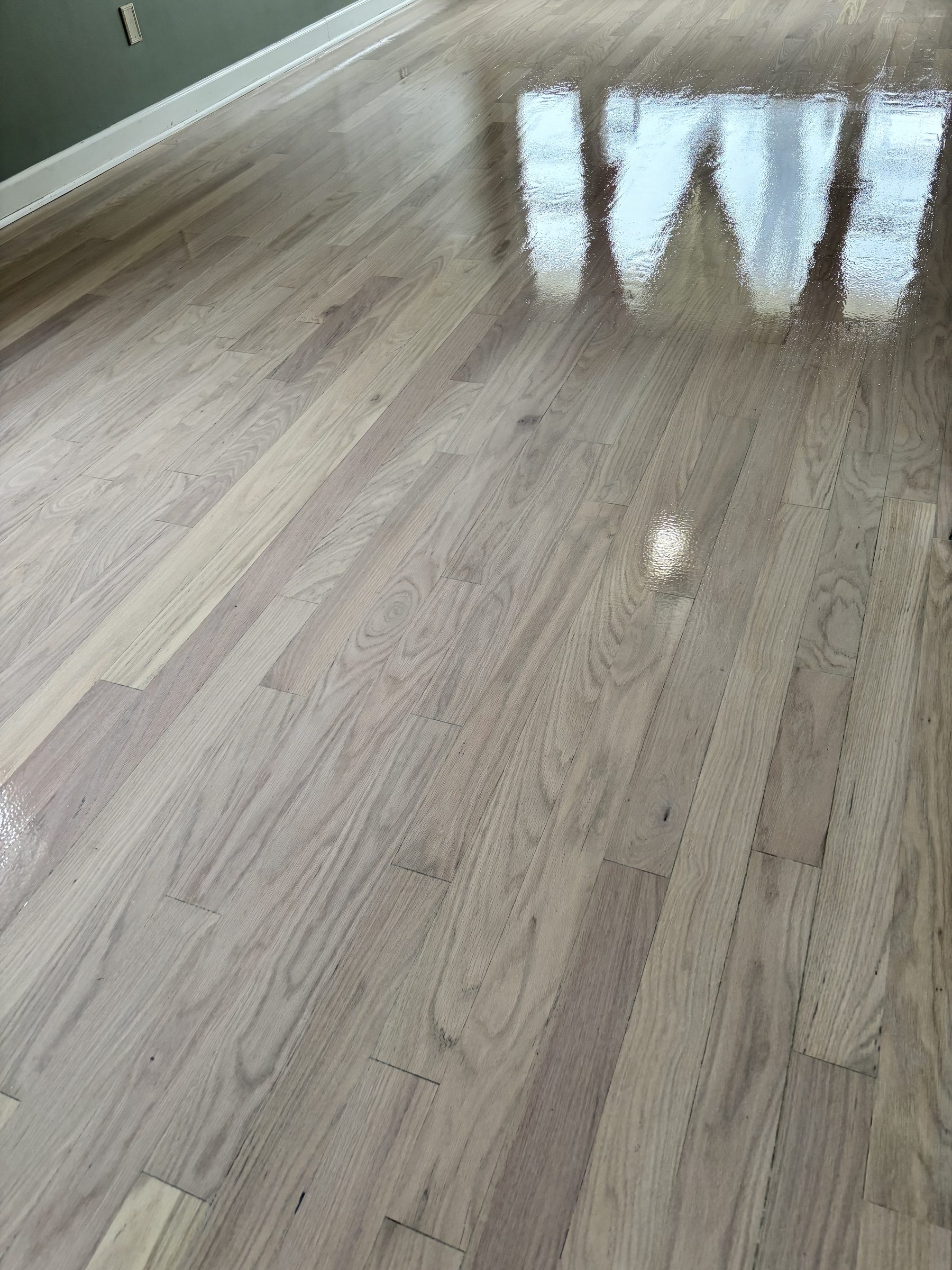
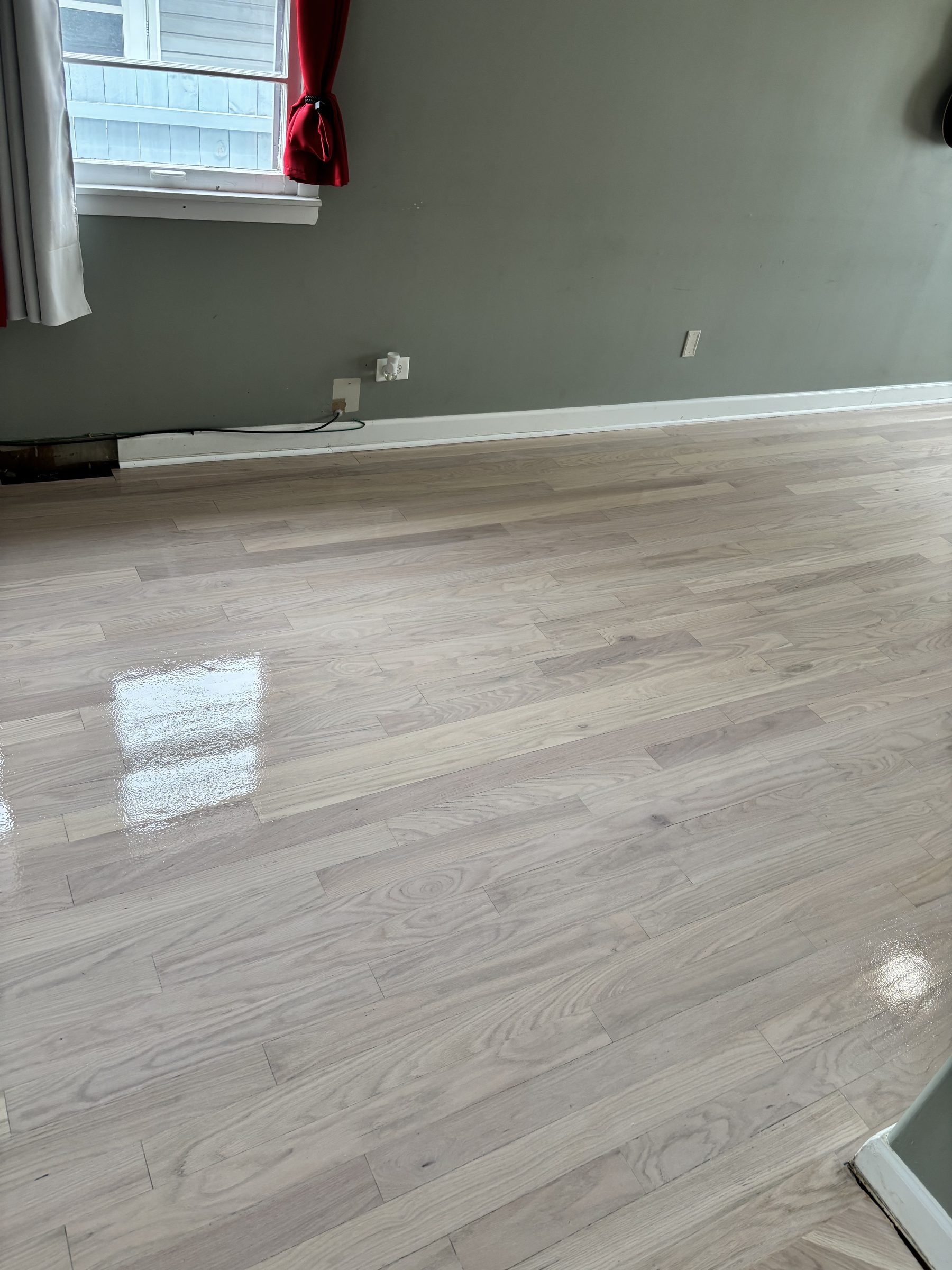
The same species of red oak that reads orange under a decade-old oil-based finish, sanded back and finished pale. The tone difference here is finish and stain choice, not different wood — the cost guide covers what a color change like this adds to a refinish.
The good news is that ambering lives in the finish and in the top fraction of an inch of wood, which is exactly what sanding removes. That is why so many refinishing calls out here start with the phrase “we want to get rid of the orange” and end well. The important part is the second half of the decision: if you sand an ambered floor back to raw and then put oil-based polyurethane on it, you have started the same clock again. If you want it to stay pale, it needs a waterborne finish.
The reverse is also true and worth saying, because taste is not universal. If you love a warm, golden, traditional oak floor, oil-based polyurethane gives you that for free and holds it. Some of the prettiest floors we have refinished were exactly that decision made on purpose.
Sheen: matte, satin, semi-gloss, gloss
Sheen is a separate choice from finish chemistry — most finishes are sold in a range of them — and it changes what you see far more than what you get.
Matte reads natural and modern, and hides scratches and dust better than anything else. It can look flat in a room with little natural light.
Satin is what we specify most often, and the reason is unglamorous: it is the best compromise anyone has found. Enough sheen to look finished, little enough to hide grit, dog prints and the fine scratching every floor collects.
Semi-gloss is brighter and traditional, and it starts showing you things. Every crumb, every dust bunny, every scuff.
Gloss is a magnifier. It is spectacular in photographs of an empty room and hard work in an occupied house with a dog.
Sheen does not meaningfully change how durable the floor is. It changes how visible the wear is, which for most people is the thing that actually determines when a floor “needs” doing again. A satin floor and a gloss floor take the same scratches; you notice them on the gloss floor three years sooner.
What Illinois’s VOC rule actually changed
Illinois limits the volatile organic compound content of architectural coatings under 35 Ill. Adm. Code Part 223, Subpart C, adopted in 2009. Two things about it are worth a homeowner knowing.
First, it applies statewide, and it applies to the person applying the coating, not only the person selling it — Section 223.305 covers anyone who supplies, sells or manufactures an architectural coating for use in Illinois “as well as any person who applies or solicits the application of any architectural coating within Illinois.” It is not a Chicago-only rule and it is not something a contractor can shop around by buying across a county line.
Second, the specific limits explain the products on the shelf. Section 223.310 caps clear varnishes at 350 grams per liter and sanding sealers at the same figure, while lacquers get 550 and conversion varnish gets 725. That 350 number is why the oil-based polyurethane a flooring contractor buys in Illinois is the reformulated 350-VOC version rather than the older, higher-solvent formulation manufacturers still publish for other states. If you have refinished a floor before and remember the smell being worse, you are not imagining it.
350 grams per liter is still a lot of solvent. Compliant does not mean low-odor. A reformulated oil-based polyurethane will still fill a closed-up house, and it is still the reason we tell families to plan on being elsewhere during finish coats. One quirk worth knowing: the rule exempts containers of one liter or less, so a quart can bought for a threshold touch-up is not necessarily the same formulation as the gallons that went on your floor.
Dry is not cured, and rugs are how people find out
Every finish has three separate milestones, and homeowners are usually told about one of them.
Recoat — the point at which the next coat can go on. Hours for waterborne, usually overnight for oil-based.
Walkable — the point at which sock feet will not mark it. Often the same day for waterborne; overnight for light traffic on oil-based.
Cured — the point at which the finish has reached full hardness and chemical resistance. This is the one measured in days or weeks, and it is the one nobody hears.
The gap between walkable and cured is where floors get damaged, and the culprit is almost always an area rug. A rug over uncured finish blocks the evaporation and air exposure the finish needs to harden. What you get is a soft patch that stays soft, a rug backing that prints its pattern into the surface, or a permanent outline where the covered area cured at a different rate than the exposed floor around it. It shows up weeks later, it is not repairable with a cleaner, and fixing it means recoating.
Furniture is the second offender, for a simpler reason: a table leg concentrates a lot of weight onto a small area of finish that has not reached full hardness yet. When furniture does come back, it gets lifted rather than dragged, and every leg gets a felt pad.
Milestone
Waterborne polyurethane
Oil-based polyurethane
Why it matters
Between coats
Hours — multiple coats can go on in a day
Typically overnight, one coat per day
Sets the length of the finishing phase
Light foot traffic
Often the same day, in socks
Overnight, per the manufacturer’s instructions
When you can get to the stairs and the bathroom
Furniture back
Days — some commercial finishes publish a three-day cure
30 days on DuraSeal’s published instructions
The number that decides your month
Area rugs back
After full cure, not before
After full cure, not before
Where the permanent damage happens
These are the published figures for common products, not a schedule for your job. The number that governs is the data sheet for the exact finish going on your floor, and we give you that number in writing before we start.
What each finish does to your week
Sanding is the same regardless of which finish you pick, and it is the noisy, dusty part. We use dust-controlled sanding, which captures the great majority of it at the machine, but fine dust still travels — vents get covered, doorways get sealed, and we recommend planning to be out during the sanding phase. Our refinishing and restoration page covers how a job runs day by day.
The finish is what changes the back half of the week.
With waterborne: most families stay in the house. Odor is mild and clears within hours. The finishing phase is short, and the schedule usually looks like a long weekend rather than a project.
With oil-based: plan to sleep elsewhere for the nights the finish coats go on, particularly with young children, pets, or anyone with respiratory sensitivity. Ventilation runs continuously. Then the room stays empty while it cures.
With hardwax oil: odor is generally modest, and the floor takes light traffic quickly, but the maintenance conversation starts immediately rather than in ten years.
Pets deserve a specific mention, because they are the most common way a plan goes wrong. A dog that walks across a floor between coats leaves prints that have to be sanded out, and a cat that gets into a closed-off room overnight is a genuinely bad morning. Boarding or a relative’s house for two or three days is cheaper than the repair.
Durability, honestly
No finish is scratch-proof, and any contractor who tells you otherwise is selling. What varies is how much abrasion a film takes before it dulls, and on that measure a good two-component waterborne finish is competitive with or better than oil-based polyurethane — which surprises people who remember the water-based finishes of the 1990s.
More to the point, abrasion resistance is rarely what ends a floor’s life. Three other things do it first: grit tracked in from a driveway, which acts like sandpaper underfoot; water standing at a kitchen sink, a dishwasher, or an entry door in a Midwest winter; and moisture swings, which move the boards themselves rather than the finish. That third one is a separate subject and a common one out here — our guide to gaps and cupping covers what an Illinois heating season does to a wood floor and how to keep it stable.
The unglamorous protections do more than the finish choice does. Walk-off mats at every exterior door. Felt pads on every chair and table leg, checked annually because they collect grit and become abrasive. Indoor relative humidity kept in the 30 to 50 percent range year-round. A floor that gets those three things will outlast the same floor with a fancier finish and none of them.
How each finish gets fixed later
This is the part of the decision that pays off in year five, and it is worth understanding before you choose.
A film finish — waterborne or oil-based — wears from the top down. While the wear is still in the finish and has not reached the wood, the fix is a screen-and-recoat: the existing finish is abraded and a fresh coat goes over it. It is dramatically cheaper and faster than a full refinish and it is the single most under-used maintenance move in flooring. The catch is timing. Once the traffic path has worn through to bare wood, recoating will not fix it and you are sanding the whole floor. The right moment is when the floor looks dull, not when it looks damaged.
A penetrating finish repairs locally by design. A scratched area gets cleaned, re-oiled and blended, and there is no film edge to give the repair away. That is the reason people with dogs keep choosing hardwax oil despite the maintenance.
Damage that goes past the finish into the boards — a pet stain that has blackened the wood, water damage under a radiator, a cracked board — is a different job in all cases, and our floor repair page covers how board replacement and spot repair work.
If your floor is prefinished, you already chose
A prefinished floor arrives from the factory with its finish already cured — usually an aluminum-oxide finish applied and UV-cured in the plant. The NWFA calls those “extremely durable,” and they are: it is a harder wear layer than anything that can be applied in an occupied house, which is exactly why long factory warranties exist.
The trade-offs arrive later. Prefinished boards usually have a micro-bevel at each edge, which is what lets them go down without site sanding, and those bevels collect dirt. And recoating a factory finish is a specialist job: the surface is engineered to resist things sticking to it, so it needs proper abrasion and adhesion preparation before a new coat will bond. It is doable; it is not a job to hand to a general handyman.
If you are choosing between prefinished and site-finished on a new floor rather than a refinish, that fork is covered in detail in our installation cost guide, along with what each option does to the price. You can also see the range of species and finishes we install on the hardwood flooring page.
Matching one room to the next
A question we get constantly: can you refinish just the family room and leave the hallway?
Physically, yes. Visually, you will see the line, and it is worth being clear about why. Three things have to match for a partial refinish to disappear: the stain color, the sheen, and the age of the finish. The third one is the problem. The old floor has been ambering and yellowing under UV for years, and a fresh finish has not started. Even the identical product from the identical can will not match a ten-year-old floor on day one.
What works is refinishing to a natural break — a doorway, a threshold, a transition strip, a change in direction — so the eye reads it as two spaces rather than one floor with a seam. What does not work is stopping in the middle of an open-plan great room, which is unfortunately where most people want to stop. Our project gallery shows a number of whole-floor jobs where the reason for doing the whole floor was exactly this.
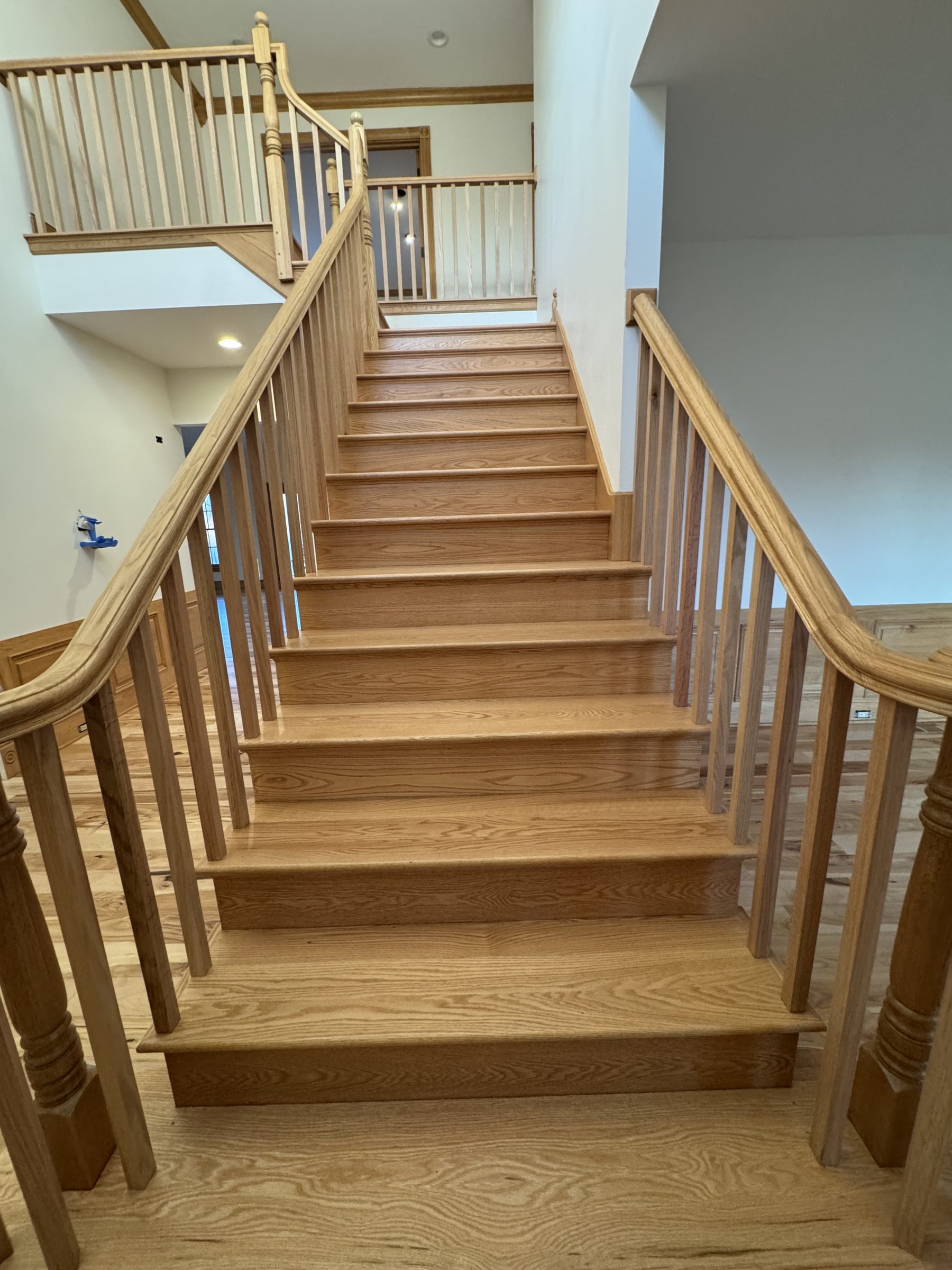
Stairs are the other matching problem. Treads, risers and railings are hand-finished, they take longer to cure than open floor, and they cannot be closed off — which is why the finish choice on a staircase changes the logistics of the whole job.
Two kinds of western-suburb floor
The housing stock out here splits fairly cleanly, and each half tends to arrive at a different answer.
Older homes: downtown Naperville, Wheaton, Geneva, St. Charles, Batavia
These floors are typically narrow-strip red oak, sometimes with several generations of finish on them, and occasionally with wax underneath a later coat of polyurethane. That last detail matters more than it sounds: wax contaminates a new finish and has to be fully removed, not sanded through, or the new coat will not bond properly. It is one of the things we check for before quoting rather than after starting.
The upside on these floors is thickness. An older solid floor usually has plenty of wood left, which means the full range of options is genuinely open — including sanding back to raw and going somewhere completely different from where the floor has been.
1990s and 2000s subdivisions: Plainfield, Oswego, Bolingbrook, Romeoville, Aurora
These are the ambered floors. Red oak, finished in oil-based polyurethane when the house was built, now twenty-plus years into warming. Almost every homeowner in this group who calls us wants the same thing: the same floor, but not orange. That is a sanding job plus a waterborne finish, and it is one of the most satisfying transformations in this trade because the wood underneath is usually in good condition.
The one thing to check first on a house of this vintage is whether the floor is solid or engineered, because engineered has a limited veneer and a limited number of sandings in it. We measure that at the estimate rather than guessing. We cover the full service area across DuPage, Will and Kane County on our locations page, and if the floor in question is below grade, the material rules are different again — see our basement flooring guide.
What we ask before choosing a finish
By the time we are standing on your floor, most of the finish decision comes out of six questions.
Who lives here. Large dogs, small children, someone with respiratory sensitivity — each one pushes the answer.
Whether the house has to stay occupied during the work, and whether there is anywhere to go for a few nights.
What the calendar looks like. A refinish four weeks before hosting Thanksgiving is a different decision than one in April.
The target color, and specifically whether you want the floor to stay where it lands or are comfortable with it warming over time.
What it has to match — adjoining rooms, stair treads, a kitchen that was done separately three years ago.
How much maintenance you will realistically do. This is the honest question behind hardwax oil, and the answer is fine either way as long as it is truthful.
We put the specific product and its published cure schedule in the quote, so the dates are not a surprise halfway through. If a finish is a bad fit for your household we will say so before you have paid for anything.
Not sure which finish is right?
We will come out anywhere in DuPage, Will or Kane County, look at what is on your floor now, check how much wood is left, and walk you through what each finish would mean for your color, your schedule and your household. No obligation either way.
For most homes in the western suburbs we recommend a commercial-grade waterborne polyurethane. It stays clear rather than ambering, so a pale or neutral floor stays that way; the odor is mild and short-lived; and the floor is back in service in days rather than a month. Oil-based polyurethane is the better answer in exactly two situations: when you specifically want the warm, golden, traditional look that ambering produces, and when budget is tight enough that the lower material cost matters more than the schedule. Both are durable. The decision is usually about color and calendar, not about quality.
With a waterborne finish, often the same day in socks. With oil-based polyurethane, the manufacturer's instruction is generally to let it dry overnight before light traffic. Those are the published figures for typical products and they assume normal conditions — drying slows down in high humidity, in a cold house, or where there is no air movement, all of which are common in a closed-up Illinois home. We give you the actual schedule for the specific product going on your floor as part of the quote.
Because a finish that is dry is not yet cured. Curing is a chemical process that continues for days or weeks after the surface feels hard, and it needs air exposure to complete. A rug laid over uncured finish blocks that, and the result is a soft patch that stays soft, a rug backing that prints its texture into the surface, or a permanent outline where the covered area cured differently from the floor around it. None of that comes out with a cleaner — the fix is recoating. DuraSeal's published instructions for its polyurethane say to allow 30 days before replacing furniture and rugs, and there is no shortcut around that number.
This is a fair worry based on the water-based finishes of the 1990s, and it no longer reflects the products a professional uses. Modern two-component waterborne finishes are clear rather than milky and are available in sheens from matte through gloss, so the plastic look people remember comes from a high sheen far more than from the chemistry. If you want a floor that reads natural, ask for matte or satin. Worth knowing that not all water-based finishes are alike — the commercial-grade two-component products cost several times what a big-box gallon costs, and they perform accordingly.
Yes, and this is the surprise that catches most people. Oil-based polyurethane is amber the day it goes down and continues to warm for years with age and UV exposure. On red oak, which already carries a pink undertone, that is where the orange floors in so many 1990s subdivisions came from — usually with no stain involved at all. A waterborne finish stays close to the color of the freshly sanded wood. If you have just paid to sand an ambered floor back to a pale, natural tone, putting oil-based polyurethane over it starts the same clock again.
Satin, for most households. It has enough sheen to look finished and little enough to hide the fine scratching, grit and pet prints every floor collects. Matte hides wear even better and reads modern, but can look flat in a room without much natural light. Semi-gloss and gloss are brighter and more traditional, and they show you everything — every crumb, every scuff, every dust bunny. Sheen does not meaningfully change how durable a floor is; it changes how soon you notice the wear, which for most people is what determines when a floor needs doing again.
Not in the products we use. A good two-component crosslinked waterborne finish is competitive with or better than oil-based polyurethane on abrasion resistance. What actually ends a floor's life is rarely abrasion anyway — it is grit tracked in from outside acting like sandpaper, standing water at sinks and entry doors, and seasonal humidity swings moving the boards themselves. Walk-off mats at every exterior door, felt pads on furniture legs checked once a year, and indoor humidity held between 30 and 50 percent will do more for your floor than any finish upgrade.
Yes, but be clear about what you will see. For a partial refinish to disappear, three things have to match: the stain color, the sheen, and the age of the finish. That third one cannot be matched — the existing floor has been ambering under UV for years and a fresh finish has not started, so even the identical product from the identical can will look different on day one. It works well when we can stop at a natural break such as a doorway, threshold or change in board direction. It does not work in the middle of an open great room, which is unfortunately where most people want to stop.